
 Counter-Strike 2
 Valorant
 Dota 2
 League of Legends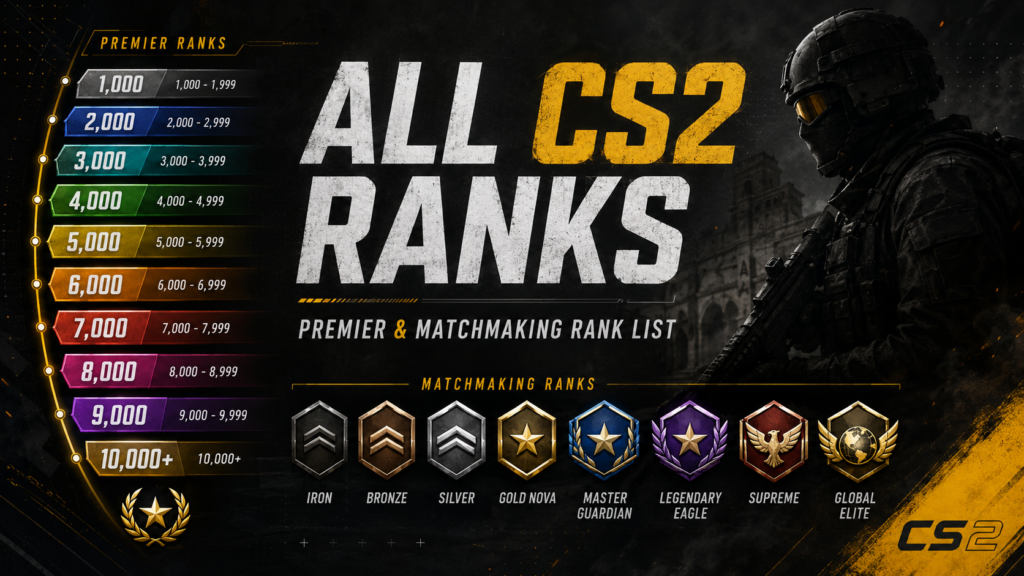
You queue into CS2, win a few games, and suddenly the game gives you two different ways to feel judged. One mode shows a number. The other shows a classic badge. Helpful? Yes. Slightly confusing? Also yes, because CS2 apparently wanted your ranked life to come with paperwork.
All CS2 ranks, CS2 ranks in order, and the CS2 ranking system are easier to understand once you split them into two systems: Premier CS Rating and Competitive Matchmaking Skill Groups. They are both ranked systems, but they do not use the same ladder.
CS2 Has Two Main Ranked Systems
For Premier and Competitive play, CS2 uses two main rank systems.
| Mode | Rank Type | What You See |
|---|---|---|
| Premier | CS Rating | A number with a color tier |
| Competitive Matchmaking | Skill Group | A classic rank badge per map |
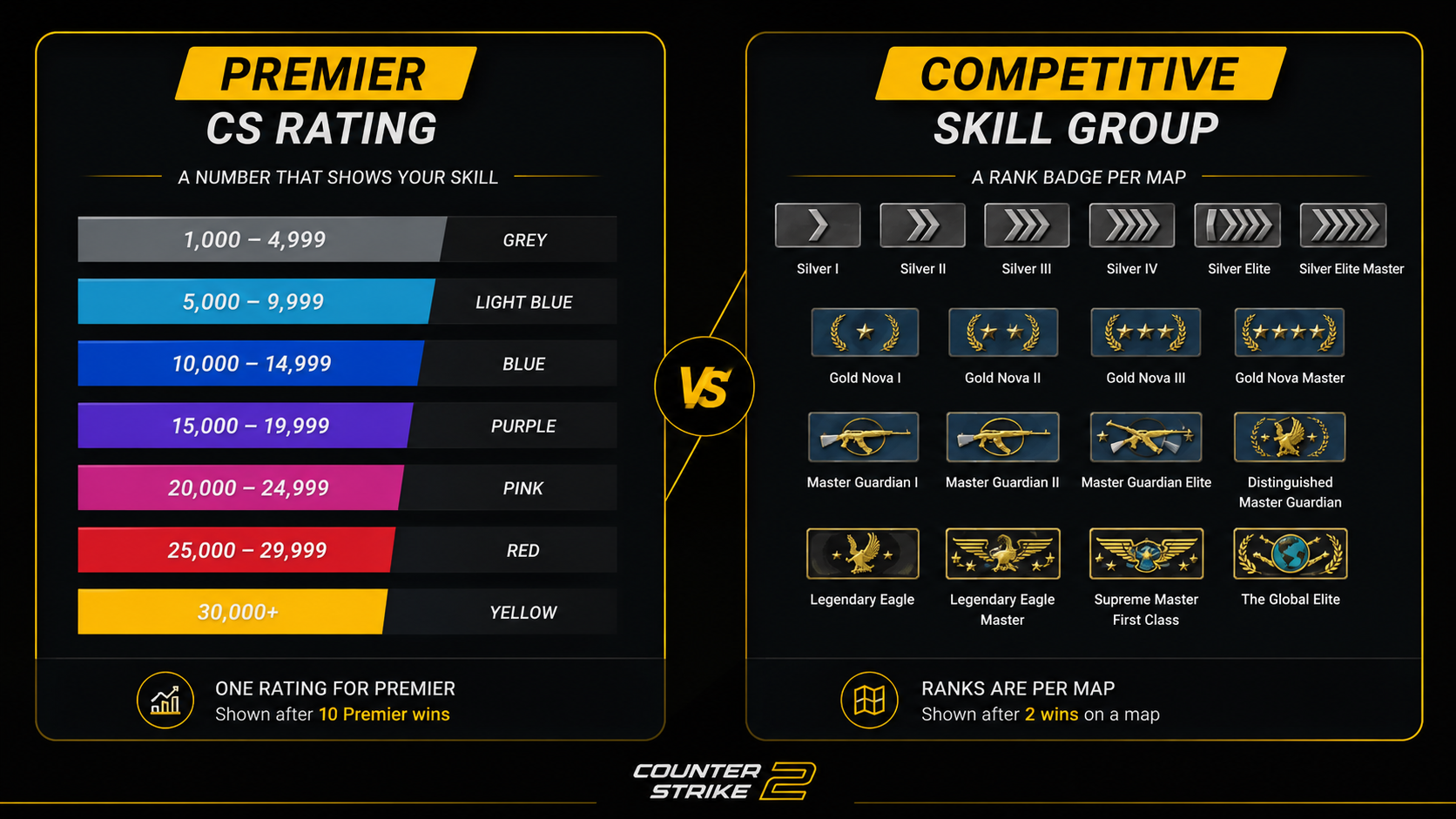
Premier uses CS Rating. This visible number, often called CS2 Premier rating or CS rating, shows your place in Premier. It also has a color, so you can quickly see which rating band you are in.
Competitive Matchmaking uses the classic Skill Groups. These are the Counter-Strike ranks many players know from CS:GO ranks and CS GO ranks lists, such as Silver I, Gold Nova Master, Legendary Eagle, and The Global Elite.
The key thing is this: Premier ranks and Competitive ranks are not the same thing.
Premier does not use Silver, Gold Nova, Master Guardian, or Global Elite. Competitive does not use Premier’s numbered color bands. If someone mixes them together, the rank list gets messy fast.
All CS2 Premier Ranks
Premier does not have traditional rank names. There is no Silver Premier or Global Elite Premier. That sounds like something someone would invent after losing three overtime games in a row.
Instead, CS2 Premier ranks are shown through CS Rating.
Your CS Rating is a number, and that number sits inside a color tier. The color does not replace the number. It just gives you a quick way to read the range.
Here is the full Premier rating list.
| Premier Tier | CS Rating Range | Display Color |
|---|---|---|
| 1 | 1,000 To 4,999 | Grey |
| 2 | 5,000 To 9,999 | Light Blue |
| 3 | 10,000 To 14,999 | Blue |
| 4 | 15,000 To 19,999 | Purple |
| 5 | 20,000 To 24,999 | Pink |
| 6 | 25,000 To 29,999 | Red |
| 7 | 30,000+ | Yellow |
Use 1,000 to 4,999 as the lowest Premier range. Some loose lists write this as 0 to 4,999, but the cleaner current way to list it is 1,000 to 4,999.
That avoids making the guide look like it is guessing. No mystery filler. No made-up labels. Just the actual rank range readers need.
What Premier CS Rating Means
CS2 Premier rating is your main ranked number in Premier.
It gives you a clearer ladder than a badge because you can see your number move over time. Instead of only thinking, “Am I close to the next rank?” you can see your progress in smaller steps.
The color tiers make that number easier to scan.
| Color | What It Tells You |
|---|---|
| Grey | You are in the lowest Premier rating band |
| Light Blue | You have moved past the first rating range |
| Blue | You are in the lower middle Premier bands |
| Purple | You are entering stronger rating territory |
| Pink | You are in a high rating range |
| Red | You are near the top public rating bands |
| Yellow | You are at 30,000 CS Rating or higher |
Do not treat these colors as official skill labels. Grey does not mean bad, and Yellow does not mean you are now legally allowed to coach everyone in chat.
The color only shows the rating band. The actual skill level in a match can still vary because players have different map knowledge, aim, utility use, team habits, and comfort on each map.
How To Get Your First Premier Rating
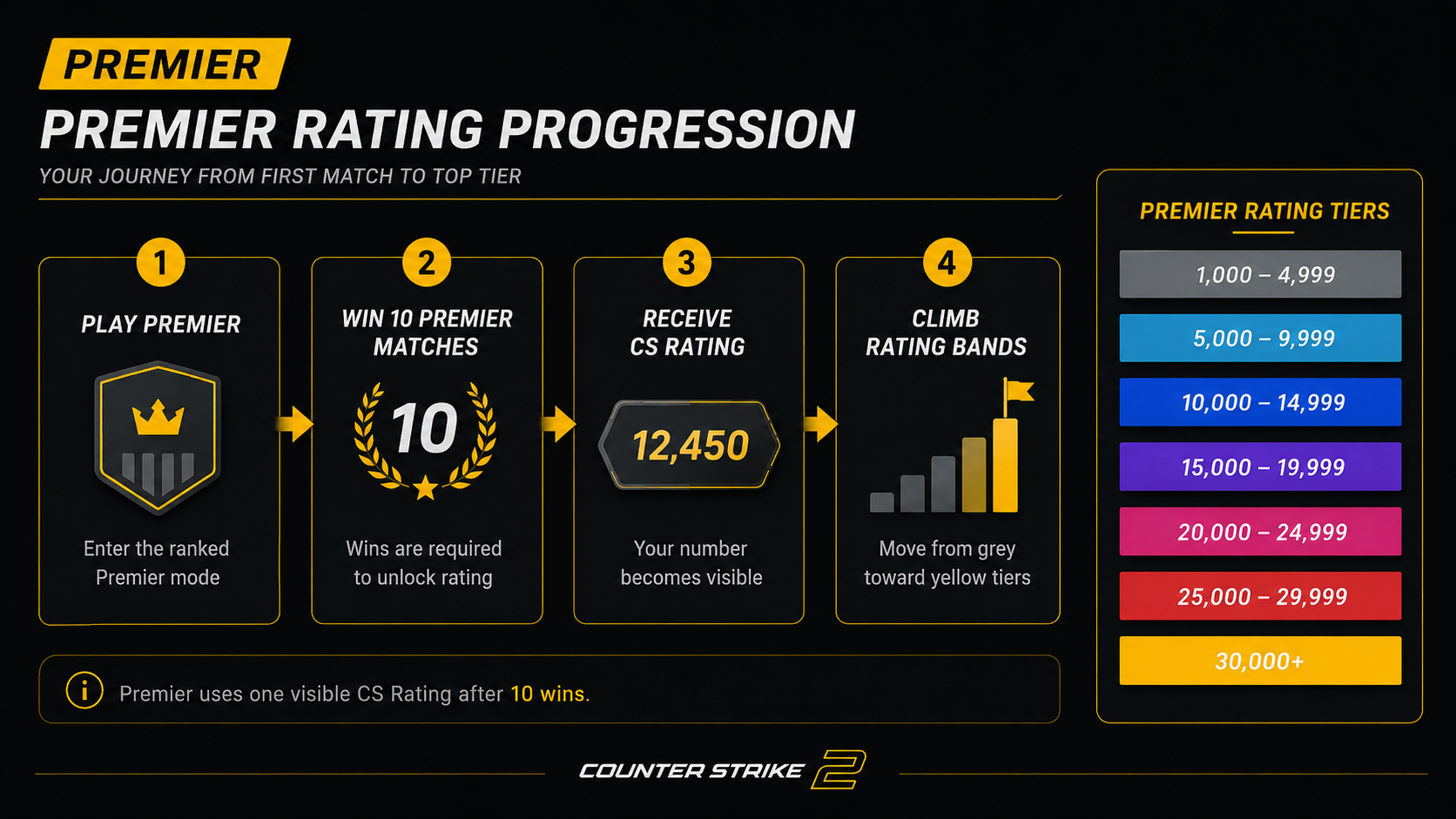
You need 10 Premier wins before your CS Rating appears.
That means wins, not matches played. If you win 10 games in a row, you get there quickly. If you lose some games, you will need to play more than 10 matches.
Here is the simple version.
| Step | What Happens |
|---|---|
| 1 | You queue Premier |
| 2 | You play matches |
| 3 | You need 10 Premier wins |
| 4 | Your CS Rating appears |
| 5 | Your number changes after later Premier results |
This is why calling it 10 placement matches can be misleading. A player may play 14, 18, or more matches before getting 10 wins.
After your rating is active, your number can move up or down based on match results. The exact ranking formula is not fully public, so avoid claiming that one stat alone controls it. Winning matters most because CS2 is still a team game, even when your teammate buys an auto-sniper for emotional reasons.
All CS2 Matchmaking Ranks
CS2 matchmaking ranks use the classic Skill Group system.
There are 18 Competitive Skill Groups in CS2. They start at Silver I and end at The Global Elite.
Here is the full CS2 rank list for Competitive Matchmaking.
| Order | CS2 Matchmaking Rank |
|---|---|
| 1 | Silver I |
| 2 | Silver II |
| 3 | Silver III |
| 4 | Silver IV |
| 5 | Silver Elite |
| 6 | Silver Elite Master |
| 7 | Gold Nova I |
| 8 | Gold Nova II |
| 9 | Gold Nova III |
| 10 | Gold Nova Master |
| 11 | Master Guardian I |
| 12 | Master Guardian II |
| 13 | Master Guardian Elite |
| 14 | Distinguished Master Guardian |
| 15 | Legendary Eagle |
| 16 | Legendary Eagle Master |
| 17 | Supreme Master First Class |
| 18 | The Global Elite |
This is the classic Counter-Strike 2 ranks list for Competitive. If you are looking for the badge ladder, this is the one you want.
CS2 Competitive Ranks By Group
The 18 ranks are easier to understand when you group them.
| Rank Family | Ranks Included |
|---|---|
| Silver | Silver I, Silver II, Silver III, Silver IV, Silver Elite, Silver Elite Master |
| Gold Nova | Gold Nova I, Gold Nova II, Gold Nova III, Gold Nova Master |
| Master Guardian | Master Guardian I, Master Guardian II, Master Guardian Elite, Distinguished Master Guardian |
| Eagle | Legendary Eagle, Legendary Eagle Master |
| Supreme | Supreme Master First Class |
| Global Elite | The Global Elite |
Silver ranks are the starting part of the ladder. This is where many players are still learning crosshair placement, map control, economy, and when not to peek the same AWP twice. The AWP has not moved. It remembers you.
Gold Nova ranks usually show more stable aim and better round sense. Players here often understand the basics, but still make mistakes with timing, utility, and trading.
Master Guardian ranks tend to show stronger map knowledge. At this level, you usually need better team play, smarter utility, and cleaner decisions.
Legendary Eagle and above are the top end of the classic Competitive badge system. Players here are usually more consistent and punish mistakes faster.
The important word is usually. A rank gives you a rough idea, not a full player report card.
How Competitive Ranks Work Per Map
This is one of the biggest CS2 rank changes compared with older CS:GO explanations.
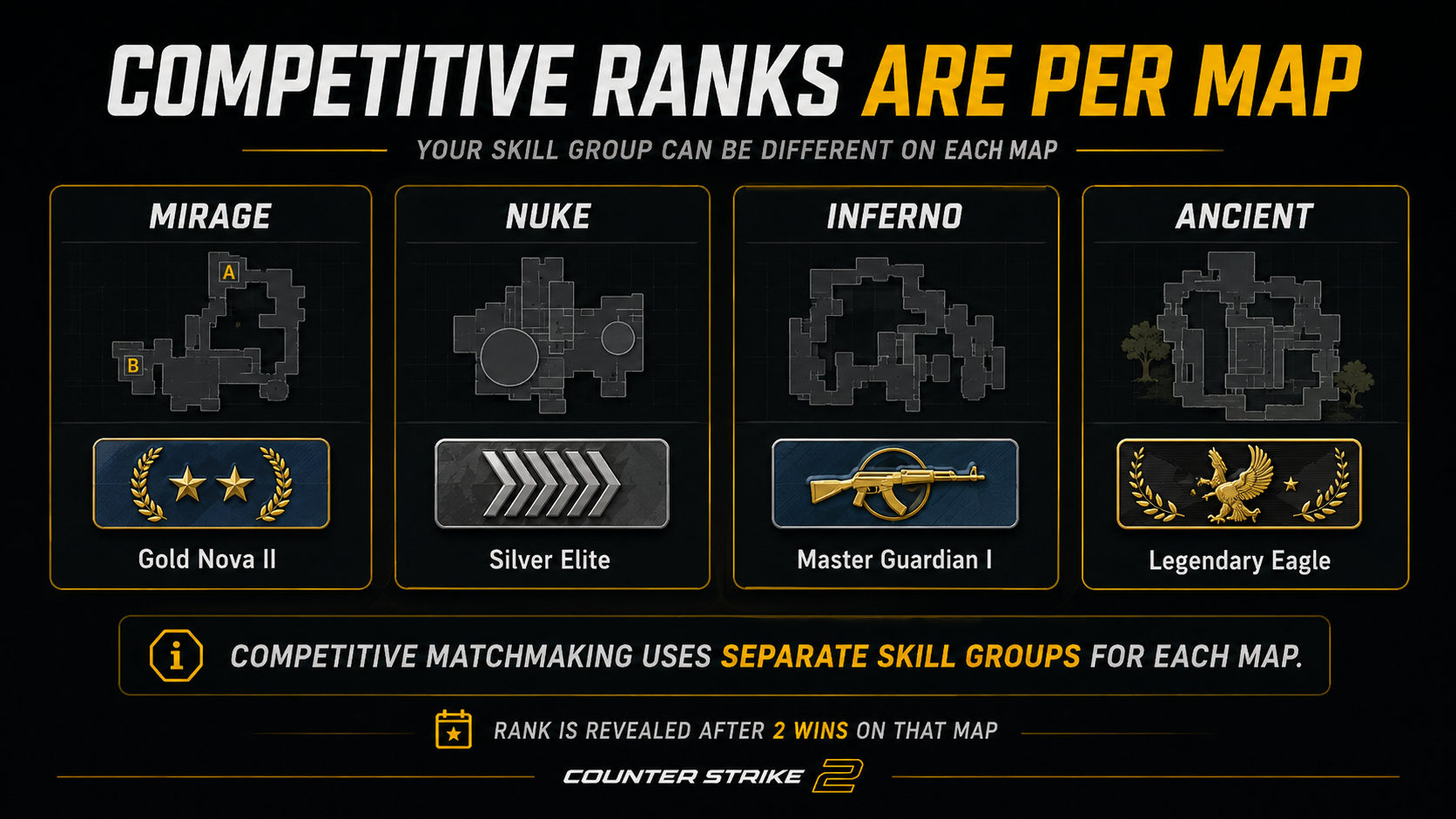
In CS2, Competitive ranks are per map.
That means you do not have one single Competitive rank for the whole mode. You can be Gold Nova II on Mirage and Silver Elite on Nuke. The game tracks those map ranks separately.
This matters because maps do not play the same way.
You may know Mirage well. You may know the window smoke, common mid timings, and where people like to hide when they think they are being clever.
Then you load into Nuke and suddenly every floor, vent, ramp, and heaven angle feels like it was designed by someone who wanted you to question your life choices.
That is why per-map ranks make sense. Your skill on one map may not match your skill on another.
To reveal a Competitive Skill Group on a map, you need two wins on that map.
| Competitive Question | Correct Answer |
|---|---|
| Is your Competitive rank account-wide? | No |
| Is your Competitive rank per map? | Yes |
| Can your rank differ by map? | Yes |
| How many wins reveal a map rank? | Two wins on that map |
Do not write that players need 10 wins per map for current CS2 Competitive ranks. That is outdated.
Premier Vs Matchmaking Ranks
Premier and Competitive Matchmaking both measure ranked progress, but they are built for different goals. CS2 XP ranks are separate from both: XP is account progression, not your Premier rank or Competitive skill group.
| Feature | Premier | Competitive Matchmaking |
|---|---|---|
| Rank Type | CS Rating number | Skill Group badge |
| Main Display | Number and color | Classic rank icon |
| Rank Scope | One Premier rating | Separate rank per map |
| First Visible Rank | After 10 Premier wins | After two wins on a map |
| Map Flow | Premier-style map pick and ban | You queue selected maps |
| Best For | One main ranked climb | Practicing specific maps |
Premier is better if you want one main rating to climb. It gives you a number that is easy to track over time.
Premier also uses a map pick and ban flow, which is why it feels closer to a team match format.
Competitive Matchmaking is better if you want to focus on specific maps. You can practice Mirage, Inferno, Nuke, or another map and build a rank there.
Neither system is fake. They just answer different questions.
Premier asks: How are you doing in Premier overall?
Competitive asks: How are you doing on this specific map?
That is the cleanest way to explain CS2 ranks and ratings without mixing systems together.
Can You Convert Premier Rating To Competitive Ranks?
You can compare them loosely, but you should not treat any conversion chart as official.
A Premier rating is not the same as a Competitive Skill Group. CS2 does not say that 10,000 rating equals Master Guardian, or that 25,000 rating equals Global Elite, so any CS2 rating to CS:GO rank, CS2 Elo to CS:GO rank, or Premier ranks to CS:GO ranks chart should be treated as an estimate.
Those charts are usually based on community guesses, personal experience, or player data from outside the game. They can be useful for rough context, but they are not official rank rules.
A safer way to say it is this:
Premier CS Rating and Competitive Skill Groups are separate systems. You can compare them loosely, but CS2 does not give an official one-to-one conversion.
That keeps your article accurate and avoids misleading readers.
Which Rank System Should You Play?
You should choose the mode based on what you want to improve.
Play Premier if you want one main ranked number. It is the better option when you want a broad climb and a clear rating to follow.
Play Competitive Matchmaking if you want to improve on specific maps. It is useful when you want to learn callouts, angles, utility, and rotations without every map being tied to one shared badge.
| Your Goal | Better Mode |
|---|---|
| You want one main ranked number | Premier |
| You want classic rank badges | Competitive Matchmaking |
| You want to practice one map deeply | Competitive Matchmaking |
| You want a Premier-style map pick and ban | Premier |
| You want separate progress by map | Competitive Matchmaking |
A smart path is to use both.
You can practice maps in Competitive, then take that map knowledge into Premier. That way, you are not learning basic positions while your Premier rating is on the line and your teammate is already typing gg after round two.
How To Rank Up In CS2
Ranking up in CS2 is not only about aim. Aim helps, of course. Nobody is asking you to win duels with positive thoughts.
But rank progress comes from winning rounds, and winning rounds comes from better decisions.
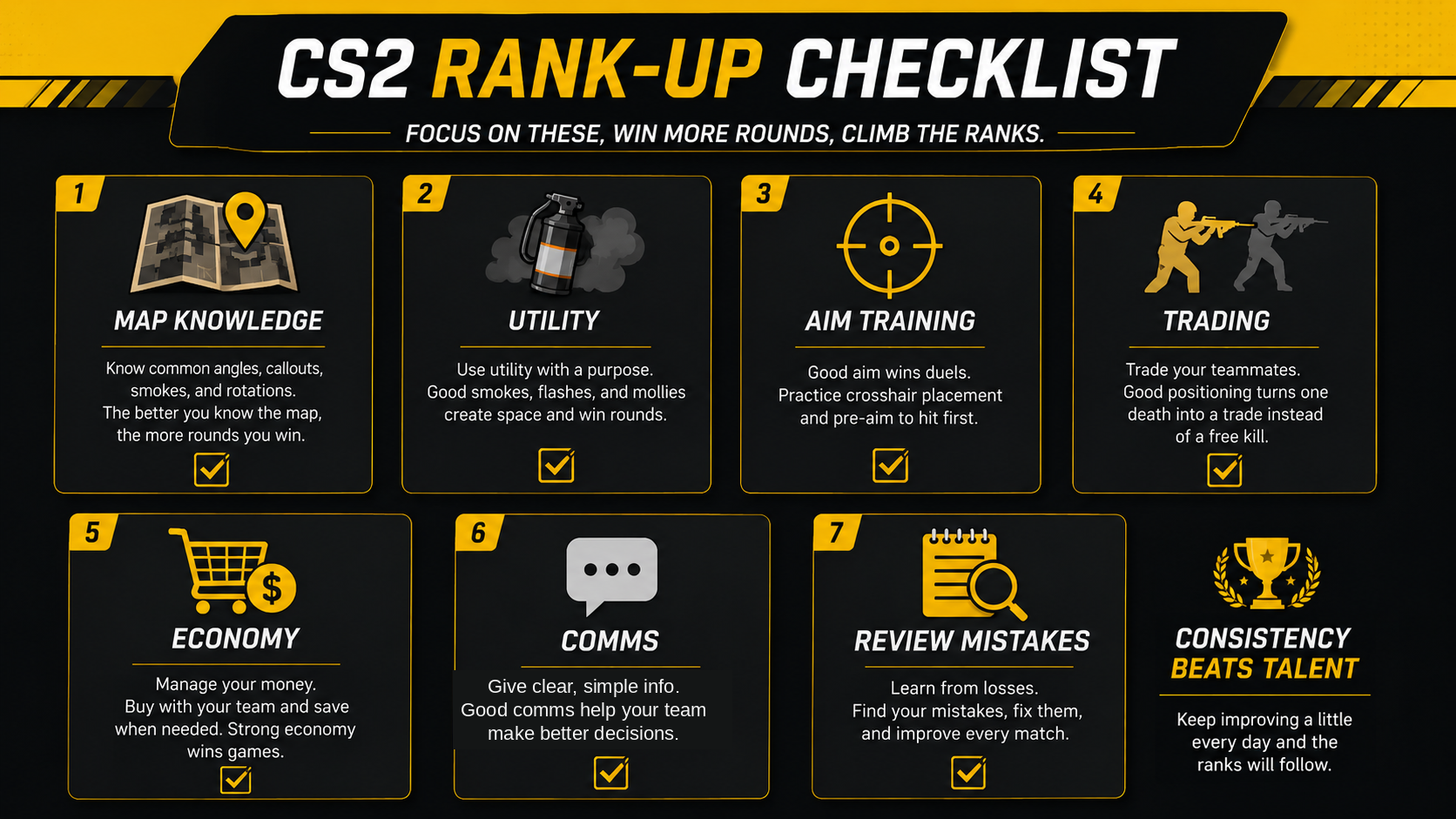
Learn The Map You Are Playing
Map knowledge is one of the easiest ways to improve because it makes every round less random.
You should know where enemies usually appear, where your team can take space, and how rotations work. This matters even more in Competitive because your rank is per map.
Focus on one or two maps first. You do not need to become a walking encyclopedia of every pixel in the map pool on day one.
| Map Skill | Why It Matters |
|---|---|
| Common angles | You stop walking into easy deaths |
| Basic smokes | You help your team take space |
| Rotation paths | You arrive before the round is lost |
| Bombsite positions | You hold and retake with more confidence |
| Callouts | You give useful info quickly |
A player with average aim and strong map knowledge can win many rounds. A player with good aim and no map knowledge can still get caught in the same bad spots again and again.
Use Utility With A Clear Purpose
Every grenade should solve a problem.
A smoke should block a dangerous angle. A flash should help someone move or take a fight. A molotov should clear a position or slow a push.
Bad utility can hurt your own team. A poor smoke can block your teammate’s view. A poor flash can blind your entry player. A random grenade may look busy, but busy is not the same as useful.
Before you throw utility, ask yourself one simple question:
What does this help my team do?
If you cannot answer that, save it for a better moment.
Train Aim Without Chasing Magic Settings
Good aim matters, but you do not need to change your crosshair every time you lose a match.
Use aim training to build steady habits. Practice short sessions where you focus on head height, clean counter-strafing, and controlled bursts.
The goal is not to become perfect in one day. The goal is to make easy shots feel easy more often.
Trade Your Teammates
Trading means you are close enough to fight the enemy after your teammate dies.
This is one of the simplest ways to win more rounds. If your teammate takes a duel and dies, you should be ready to punish the enemy before they reset.
Bad spacing turns one lost duel into a free kill for the other team. Good spacing turns one death into a trade, which keeps the round playable.
You do not need perfect team coordination for this. You just need to avoid playing so far away that your teammate dies alone while you are still admiring the wall texture.
Manage Your Economy
Buying at the wrong time can lose rounds before they start.
If your team is saving, you usually should not force buy alone. If your team is buying, you should try to buy with them. The goal is to have several strong rounds together, not one lonely hero round with a pistol and a dream.
Watch your team’s money before you buy.
| Situation | Better Choice |
|---|---|
| Most teammates are saving | Save with them |
| Most teammates can buy rifles | Buy with them |
| You are low on money but team can buy | Buy useful utility if possible |
| You are unsure | Ask before buying |
Good economy habits help you get more full buy rounds. More full buy rounds give you better chances to win.
Communicate Simple Info
You do not need to talk nonstop. You need to give useful info.
Good communication is short and clear.
| Weak Comms | Better Comms |
|---|---|
| “They are everywhere” | “Two B apps, bomb seen” |
| “He is low” | “AWP ramp, tagged once” |
| “Help me” | “One pushing short now” |
| “I died” | “One palace, no armor seen” |
Say what you saw, where it happened, and what matters next.
You can keep it calm. Your team does not need a dramatic radio play every time someone crosses mid.
Review Your Own Mistakes
Some losses are your team’s fault. Some losses are your fault. Most matches have a bit of both.
If you want to rank up, look for patterns in your own play.
Ask yourself:
-
Are you dying first too often?
-
Are you rotating too early?
-
Are you saving utility too long?
-
Are you taking the same bad duel every round?
-
Are you buying when your team is saving?
You do not need to fix everything at once. Fix one repeated mistake, then move to the next.
That is how you make steady progress without turning every loss into a therapy session in voice chat.
Common CS2 Rank Mistakes To Avoid
A lot of rank confusion comes from using old CS:GO ideas or mixing Premier with Competitive. These are the big mistakes to avoid.
Do Not Mix Premier With Competitive
Premier has CS Rating.
Competitive has Skill Groups.
A Yellow Premier rating is not officially called Global Elite. Global Elite is a Competitive rank.
Do Not Say Competitive Ranks Are Account-Wide
CS2 Competitive ranks are per map.
If you write that a player has one Competitive rank across every map, the guide is wrong.
Do Not Use Outdated Placement Rules
For Premier, your CS Rating appears after 10 Premier wins.
For Competitive, your map rank appears after two wins on that map.
These are different requirements, so keep them separate.
Do Not Treat Community Conversions As Official
Premier rating conversion charts can be interesting, but they are not official.
You can mention that players compare the systems, but do not present those comparisons as confirmed CS2 rank data.
Do Not Include Wingman Unless The Article Covers It
Wingman has ranked play, but it is not part of this Premier and Competitive Matchmaking rank list.
If the article is about Premier and Matchmaking, keep the focus there. Adding Wingman can confuse readers unless the page is clearly about every ranked mode in CS2.
Quick Rank Reference
Here is the short version if you just need the key facts.
| Topic | Correct Data |
|---|---|
| Premier Rank Type | CS Rating |
| Premier Rating Display | Number plus color |
| Premier Rating Reveal | After 10 Premier wins |
| Premier Color Tiers | Grey, Light Blue, Blue, Purple, Pink, Red, Yellow |
| Lowest Premier Range | 1,000 to 4,999 |
| Highest Premier Range | 30,000+ |
| Competitive Rank Type | Skill Group |
| Competitive Rank Count | 18 ranks |
| Lowest Competitive Rank | Silver I |
| Highest Competitive Rank | The Global Elite |
| Competitive Rank Scope | Per map |
| Competitive Rank Reveal | Two wins on that map |
This is the safest reference to use if you want a clean CS2 ranks explained section without mixing different systems.
Conclusion
CS2 ranks are simple once you stop forcing Premier and Competitive into the same ladder.
Premier gives you a numbered CS Rating with color tiers. Competitive Matchmaking gives you classic Skill Group badges for each map.
If you want one main climb, play Premier. If you want to build map-specific skill, play Competitive. Either way, learn the maps, use utility with purpose, and please do not dry peek the same AWP four rounds in a row.
FAQs
What Is The Highest Rank In CS2?
The highest Competitive Matchmaking rank is The Global Elite.
In Premier, the highest listed color tier is Yellow, which starts at 30,000+ CS Rating.
What Is The Lowest Rank In CS2?
The lowest Competitive rank is Silver I.
The lowest Premier CS Rating range is 1,000 to 4,999, shown in Grey.
How Many CS2 Competitive Ranks Are There?
There are 18 CS2 Competitive ranks.
They start at Silver I and end at The Global Elite.
Are CS2 Premier Ranks The Same As Competitive Ranks?
No. Premier uses CS Rating, while Competitive Matchmaking uses Skill Groups.
You should not call a Premier rating Silver, Gold Nova, Master Guardian, or Global Elite.
How Do You Get A Premier Rank In CS2?
You need to win 10 Premier matches to reveal your CS Rating.
Losses do not count toward those 10 wins, so you may need more than 10 matches.
How Do You Get A Competitive Rank In CS2?
You need to win two matches on a map to reveal that map’s Competitive Skill Group.
Each map has its own rank.
Why Do I Have Different Ranks On Different Maps?
CS2 Competitive ranks are per map.
You can be stronger on one map than another, so the game tracks those ranks separately.
Can You Convert CS2 Premier Rating To Matchmaking Ranks?
Not officially.
Players may compare Premier rating to Competitive ranks, but CS2 does not provide a confirmed one-to-one conversion.
Is Global Elite Still In CS2?
Yes. The Global Elite is still the highest classic Competitive Skill Group in CS2.
It belongs to Competitive Matchmaking, not Premier.
Do You Need Prime Status For CS2 Ranks?
You need Prime Status to receive Competitive Skill Groups and Counter-Strike Ratings.
That means Prime matters if you want official ranked progress instead of only casual play.
Are Profile Ranks The Same As Skill Groups?
No. Profile ranks are separate from Competitive Skill Groups and Premier CS Rating.
Profile progress is tied to account XP, while Skill Groups and CS Rating are tied to ranked play.
Should You Play Premier Or Competitive First?
Play Competitive first if you want to learn maps without focusing on one main rating.
Play Premier when you want a single ranked number and a more serious climb.
Written by

Muhib Nadeem
11 published articles
CS2 writer and BO5 editor covering Counter-Strike guides, rankings, skins, and performance fixes.
Recommended posts
August 9, 2026
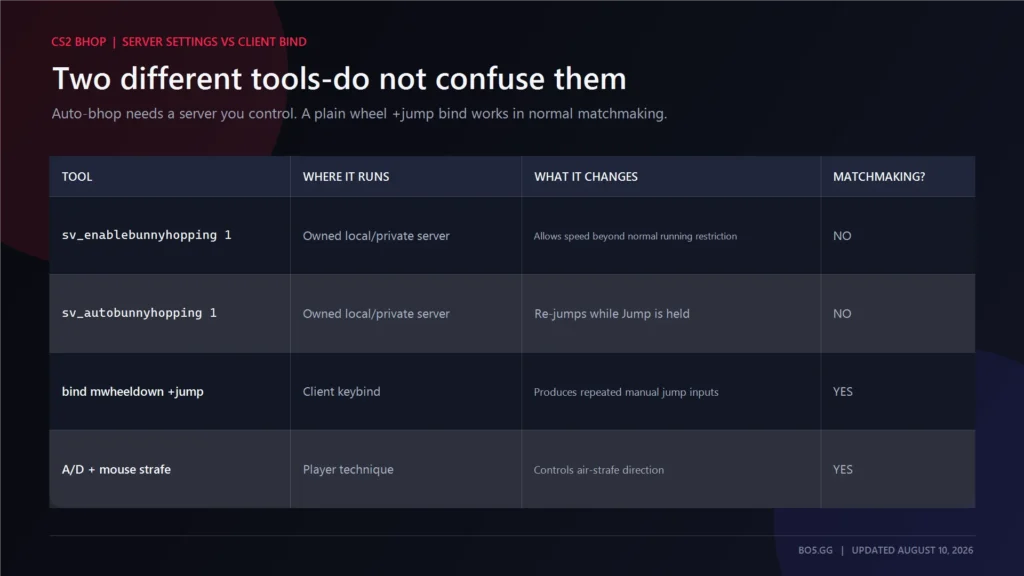
CS2 Bunny Hop Command: How to Enable Bhop
Enable auto-bhop on a CS2 server you control, adjust optional practice settings, use a matchmaking-safe wheel bind, and restore every value correctly.
August 9, 2026
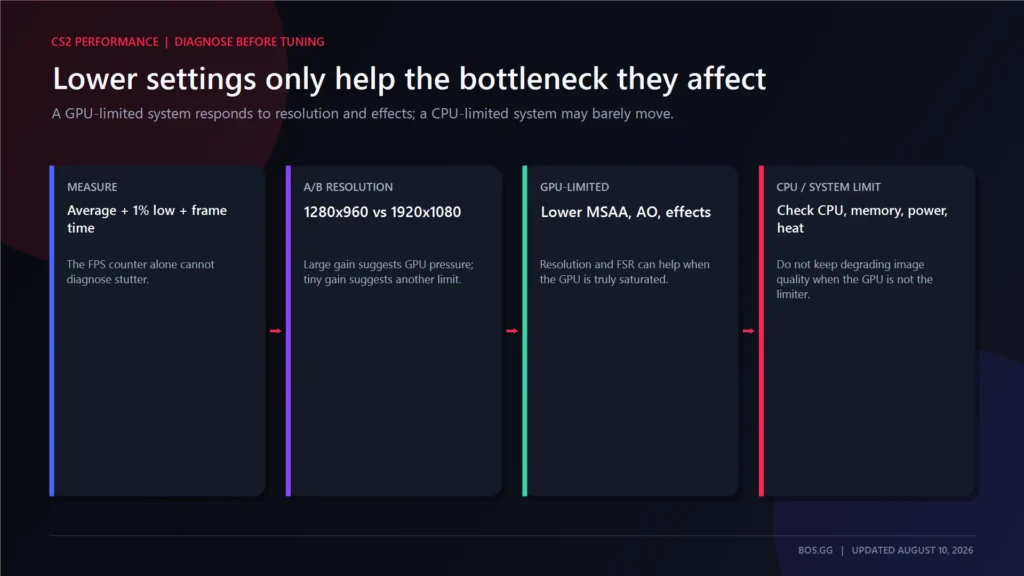
Best CS2 Settings for FPS and Lower Input Lag
Choose CS2 settings for your hardware and display, separate lowest latency from tear-free VRR, preserve competitive visibility, and benchmark every change.
August 9, 2026
CS2 Viewmodel Settings: Every Command, FOV and Pro Config
Configure your CS2 viewmodel with current commands, defaults, practical presets and dated pro snapshots—without confusing weapon FOV with camera FOV or FPS.