
 Counter-Strike 2
 Valorant
 Dota 2
 League of Legends
In CS2, a kill tells you who finished the fight, but ADR shows how much damage you actually produced across the rounds you played. That makes it one of the quickest ways to see whether you are consistently contributing in gunfights, even when teammates secure the final kill.
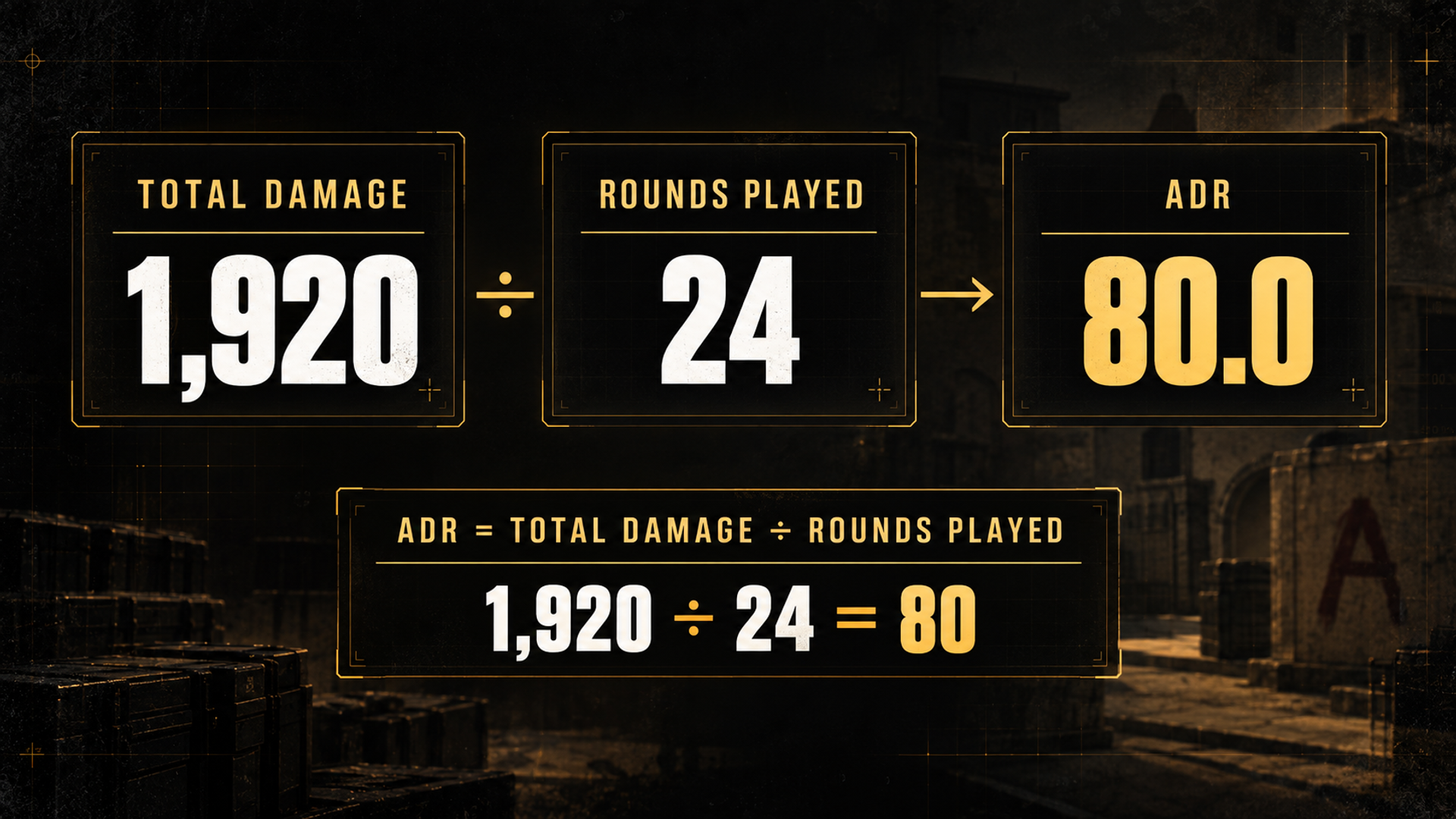
ADR means Average Damage per Round. It is calculated by dividing your total effective damage to enemies by the number of rounds played. If you deal 1,920 damage across 24 rounds, 1,920 ÷ 24 = 80 ADR. ADR matters because it captures useful damage output even when that damage does not turn into a kill for you.
What Does ADR Mean in CS2?
If you are asking what is ADR in CS2, the simplest answer is that it measures your average enemy damage per round. Instead of counting only kills, it asks how much health you remove from opponents over the course of a match.
That distinction matters. You can deal heavy damage to an enemy, die, and finish the round with no kill. Your K/D gets nothing from that exchange, but ADR still records the damage you created. If a teammate immediately finishes that opponent, your damage may have been one of the reasons the trade was easy.
ADR is also not a new idea invented for CS2. Valve was already referring to ADR by name in its 6 July 2018 release notes for CS:GO, and the basic stat is unchanged.
What Is a Good ADR in CS2?
There is no official universal Valve cutoff for a “good” ADR. Valve does not publish a matchmaking-wide table saying that one number is average, another is good, and another is elite.
The ranges below are best treated as community shorthand, not measured matchmaking percentiles.
| ADR range | Community shorthand | How to read it |
|---|---|---|
| 70–79 | Solid | A shorthand for steady damage, but role, map and sample size still matter. |
| 80–89 | Good to strong | 80 ADR is generally considered good because it represents meaningful damage contribution across rounds. |
| 90+ | Very strong | Usually describes heavy damage output in a match or sample, not an official skill threshold. |
These bands summarize current community convention as reviewed by BO5 on 12 September 2026; they are not Valve benchmarks or measured matchmaking percentiles. As a dated reality check rather than a universal standard, the top damage figure in HLTV’s 11 September 2026 NOIR VERSE vs BEBOP map was 88.7 ADR over 29 rounds. BO5’s own parsed-match distribution will replace this interim community benchmark.
So, is 80 ADR good in CS2? Generally, yes. It is sensible shorthand for a strong damage contribution over a meaningful sample. But do not turn 80 into a universal law. A support player, AWPer, entry, lurker and high-volume rifler can all produce different damage patterns while still helping their team.
What matters most is context: your role, the maps you play, how often you take opening fights, how much utility damage you produce, and whether the sample is one map or many.
How ADR Is Calculated
The formula is simple: ADR = total effective enemy-health damage ÷ rounds played. If you deal 1,920 damage in 24 rounds, 1,920 ÷ 24 = 80 ADR.
The important word is effective. ADR tracks damage that actually removes enemy health, not every nominal damage number a weapon could theoretically deal.
| Situation | Counts toward ADR? | What happens |
|---|---|---|
| Bullet or weapon damage | Yes | Enemy health removed contributes to your damage total. |
| HE grenade or Molotov/incendiary damage | Yes | Damaging utility counts when it removes enemy health. |
| Friendly fire | No | Valve explicitly fixed ADR to filter out team damage in its 6 July 2018 notes. |
| Overkill | Only remaining health | If an enemy has little HP left, the killing hit can only remove the health that remains. |
| Already-dead enemy | No | A dead player has no remaining health to remove, so shooting the body adds no ADR. |
| Armor damage | Do not add it separately | ADR should be understood as effective enemy-health damage, not health damage plus a second armor total. |
| Non-damaging utility | No | Flashbangs, smokes and other utility that does not remove health do not add damage. |
For multiple maps, use round weighting. Add the total damage from every map and divide by the total rounds across those maps. Do not simply average each map’s ADR unless the maps contain the same number of rounds.
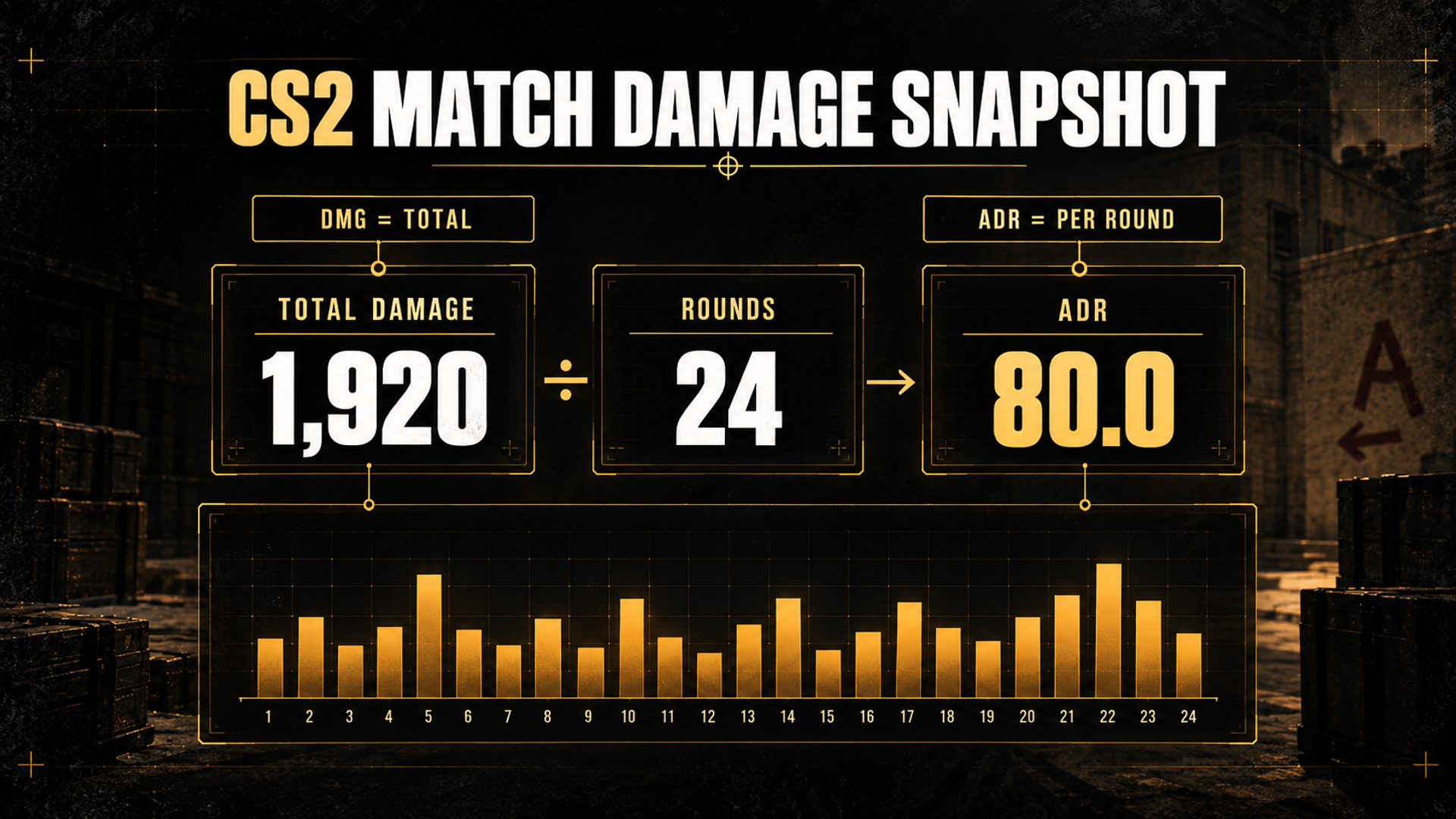
On the scoreboard, total Damage or DMG and ADR are related but not identical. Damage is your cumulative damage total. ADR normalizes that total by rounds played. Open the scoreboard and switch to its additional statistics view to see ADR during a match; post-match statistics also surface the number.
For a deeper view, the CS2 stats tracker parses ADR from uploaded match demos, making it easier to compare several matches instead of judging yourself from one scoreboard.
ADR by Role
Roles change how often a player fights, what kinds of fights they take, and how much value comes from damaging utility versus direct duels. There are no official Valve role-specific ADR ranges, so role context is more defensible than invented target numbers.
| Role | How role context can affect ADR |
|---|---|
| AWPer | AWPers may take fewer engagements and save more often than aggressive riflers. HLTV’s 29 October 2025 Rating 3.0 adjustment notes say AWPers tend to have lower ADR, so the idea that the AWP automatically inflates ADR is too simple. |
| Entry | Entries take high-risk opening fights. They can deal major early damage, die, and still leave teammates an easy trade, so ADR can look healthier than K/D. |
| Rifler | Riflers often take a broad mix of gunfights and utility-assisted fights. Anchors, rotators and aggressive riflers can still produce very different damage patterns. |
| Support | Support players create value through flashes, smokes, spacing and setup work that ADR cannot fully capture. Their damaging utility does count. |
| Lurker | Lurkers often have irregular engagement timing. Late-round fights, isolated duels and cleanup situations can change the relationship between ADR and K/D. |
The useful lesson is not that every role needs a target number. It is that ADR becomes more meaningful when you know what the player was actually asked to do.
ADR vs K/D, KAST and Rating
ADR and K/D answer different questions. ADR measures damage output per round. K/D tells you how many kills you secure relative to deaths. A player can have strong ADR with an ordinary K/D by repeatedly dealing heavy chip damage, creating assists, landing utility damage or taking risky opening fights that teammates finish.
KAST is the percentage of rounds in which a player recorded a kill, assist, survived, or was traded.
Rating is broader still. HLTV’s 20 August 2025 Rating 3.0 methodology uses several components rather than treating damage as a complete measure of performance, including damage, kills, survival, KAST, multi-kills and Round Swing.
That is why ADR should be read as one strong signal, not a final verdict. For broader skill context, see CS2 ranks and Premier rating explained, and for professional examples, browse CS2 pro player profiles.
How to Raise Your ADR
The goal is not to farm damage for its own sake. Better ADR should come from taking more useful fights and extracting more value from the fights you already take.
- Improve first-bullet accuracy and spray control. More clean hits mean more engagements produce useful damage, even when you do not get the kill.
- Learn reliable HE and Molotov lineups. Damaging utility can add consistent impact without forcing unnecessary duels.
- Stay close enough to trade. Better spacing creates more meaningful engagements and fewer rounds where you die without contributing.
- Review low-damage rounds. Rounds where you do almost no damage often expose poor positioning, bad timing or utility used without a clear purpose.
- Do not chase the stat in lost rounds. Saving a weapon, protecting economy and playing the objective can matter more than padding damage.
- Track a meaningful sample. One explosive map can flatter your ADR just as easily as one terrible map can drag it down.
When reviewing your own matches, compare ADR with deaths, opening fights, utility usage and role. The number becomes more useful when it helps explain a pattern instead of becoming the pattern you are trying to force.
CS2 ADR Questions
Is an ADR of 80 good in CS2?
Yes. An ADR of 80 is generally considered good community shorthand because it suggests you are contributing meaningful damage across rounds. It is not an official Valve cutoff, so treat it as context rather than a rank-equivalent threshold.
What is the difference between ADR and damage on the scoreboard?
Scoreboard Damage or DMG is your total accumulated damage. ADR divides that damage by the rounds played. For example, 1,920 total damage over 24 rounds equals 80 ADR.
Does utility damage count towards ADR?
Yes, damaging utility does. HE grenades and Molotov or incendiary damage count when they remove enemy health. Flashbangs and smokes do not add ADR simply because they affect an opponent.
Why do pros have higher ADR than their K/D suggests?
Because ADR credits damage even when the player does not secure the kill. A pro can repeatedly deal heavy opening damage, create easy trades, land utility damage or soften several opponents while teammates finish the frags.
Where can I see my ADR in CS2?
You can see ADR from the in-game scoreboard’s additional statistics view and in post-match statistics. For live professional context, you can also check today’s CS2 matches.
Recommended posts

August 30, 2026
FACEIT Ranks and Elo Explained: Every Level in CS2
Current FACEIT CS2 Elo thresholds, every skill level, Season 9 soft-reset rules, Challenger status, party modifiers, leavers, and Premier limits.

August 30, 2026
How to Start Private Matchmaking in CS2
Choose the correct CS2 private-play route, start a ten-human Private Matchmaking pool, preserve teams, and diagnose lobby or server failures safely.

August 30, 2026
How to Unlock Premier in CS2
CS2 Premier requires Prime Status and Profile Level 10 on the same account. This guide separates access, rating calibration, XP planning, and safe lock troubleshooting.