
 Counter-Strike 2
 Valorant
 Dota 2
 League of Legends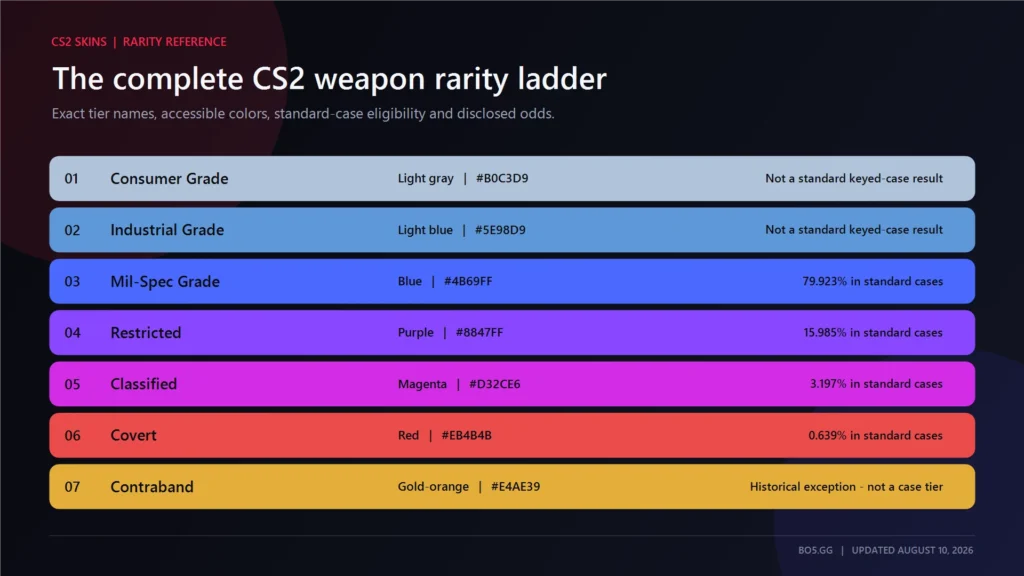
The rarity bar beside a CS2 item shows its assigned grade or quality. It does not tell you how worn the item is, how unusual its pattern looks, or how much somebody will pay for it.
Direct answer: The CS2 and legacy CS:GO weapon-skin rarity order is Consumer Grade, Industrial Grade, Mil-Spec Grade, Restricted, Classified, Covert, then the exceptional historical Contraband designation. Standard keyed cases contain Mil-Spec through Covert weapons, plus a separate Exceedingly Rare Special Item result. Rarity is a supply signal, not a price tag, and it is separate from float, exterior, pattern, StatTrak and Souvenir status.
Key Takeaways
- The normal weapon ladder runs from Consumer Grade to Covert, with Contraband as an exceptional historical designation.
- Standard keyed cases begin at Mil-Spec Grade. Consumer Grade, Industrial Grade and Contraband are not regular results in that structure.
- The gold-presented case result is an Exceedingly Rare Special Item slot, not one universal item rarity.
- Knives use Covert in direct item metadata, while gloves use Extraordinary.
- Float, exterior, Pattern Template, StatTrak, Souvenir status, collection and market price do not change an item’s base rarity.
CS2 Skin Rarity Order, From Consumer Grade to Contraband
Players use rarity, grade, tier and quality for closely related concepts. This guide uses rarity as the general term while preserving each item’s exact label.
The color names below are written out for accessibility. The hex values are reference tokens associated with current CS2 data and should never replace the written tier name.
| Order | Exact weapon rarity | Accessible color name | Reference hex | Standard keyed-case odds | Regular standard-case result? |
|---|---|---|---|---|---|
| 1 | Consumer Grade | Light gray | #B0C3D9 |
— | No |
| 2 | Industrial Grade | Light blue | #5E98D9 |
— | No |
| 3 | Mil-Spec Grade | Blue | #4B69FF |
79.923% | Yes |
| 4 | Restricted | Purple | #8847FF |
15.985% | Yes |
| 5 | Classified | Pink or magenta | #D32CE6 |
3.197% | Yes |
| 6 | Covert | Red | #EB4B4B |
0.639% | Yes |
| 7 | Contraband | Orange or gold-orange | #E4AE39 |
— | No; historical exception |
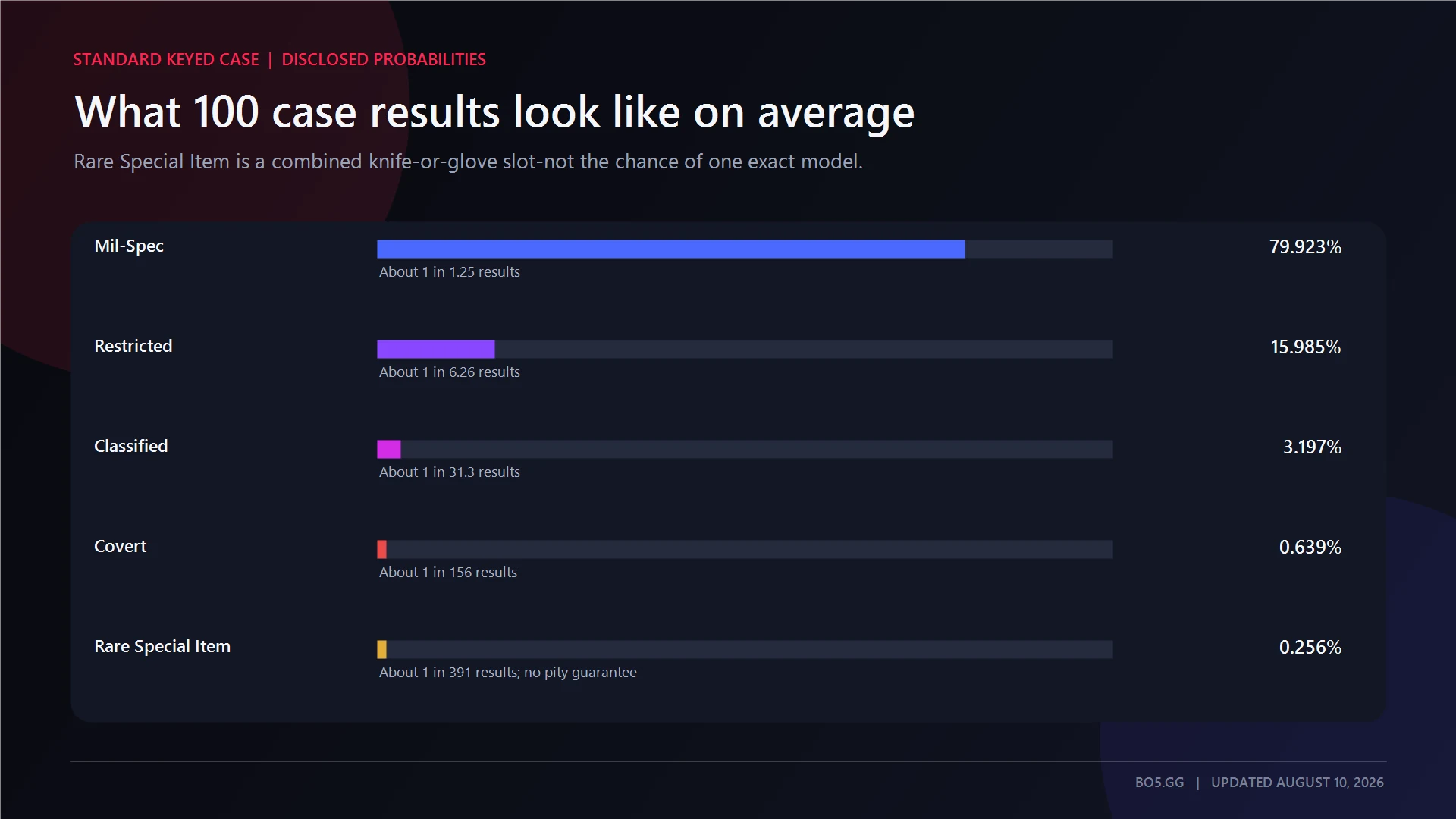
Valve’s 2017 China probability disclosure also gives a 0.256% chance of an Exceedingly Rare Special Item. That result is separate from the seven-row weapon chart because the case presentation and the resulting item’s own quality label are not always the same.
Where supported, StatTrak has a conditional chance of approximately one in 10 after the applicable item outcome is selected. StatTrak does not create another rarity tier.
These figures describe the standard keyed-case structure. Armory collections, souvenir packages, sticker capsules, charm collections and some terminal systems use different ladders or probabilities.
For expected value rather than rarity definitions, see BO5’s guide to how CS2 case ROI is calculated. Official drop odds do not tell you whether a case is profitable to open.
Consumer Grade
Consumer Grade is the lowest normal collectible weapon-skin tier. It appears mainly in map, operation and other collection-based pools rather than the standard four-tier contents of a keyed weapon case.
The Nova | Sand Dune and P250 | Sand Dune are familiar examples. A Consumer Grade item can still become expensive when its collection stops supplying new copies.
Industrial Grade
Industrial Grade sits above Consumer Grade and uses a light-blue label. It appears in collection-based systems, including pools that begin below Mil-Spec Grade.
Industrial Grade is not part of the normal Mil-Spec-to-Covert keyed-case structure. That does not mean it is absent from every container or acquisition system in CS2.
Mil-Spec Grade
Mil-Spec Grade is the lowest regular weapon outcome in a standard keyed case. Its official probability is 79.923%, making it the most common result in that structure.
The AK-47 | Uncharted is a Mil-Spec example. The complete label matters because several other item families also use blue while assigning it a different name.
Restricted
Restricted is the purple tier above Mil-Spec Grade. Its standard-case probability is 15.985%.
That percentage applies to the rarity outcome. It is not automatically the chance of receiving one exact finish, exterior, float or StatTrak version.
Classified
Classified uses a pink or magenta label and sits above Restricted. Its standard-case probability is 3.197%.
The AK-47 | Ice Coaled is one example. A Classified skin can cost less than a Restricted skin when weapon demand, collection supply or current market activity differs.
Covert
Covert is the red tier and the highest regular firearm result in a standard keyed case. Its official probability is 0.639%, or roughly one result in 156 openings over a sufficiently large sample.
The Desert Eagle | Printstream, AWP | Dragon Lore and AK-47 | Fire Serpent are Covert finishes. Readers looking for lower-cost examples can compare the cheapest Covert skins in CS2.
Contraband
Contraband is an exceptional historical designation rather than a normal case, collection or trade-up tier.
Valve assigned it to the redesigned M4A4 | Howl and the Howling Dawn sticker after a 2014 copyright dispute and removed their original creation route. No ordinary case roll progresses from Covert to Contraband.
The game’s historical designation and the current marketplace quality field must be kept separate. Valve’s announcement identifies the items as Contraband, while current Steam Market metadata may describe the M4A4 | Howl as Covert and the Howling Dawn sticker as High Grade.
Contraband is therefore a special historical classification. It should not be presented as a routinely obtainable modern tier or silently replaced with the marketplace label.
What the Rarity Colors Mean
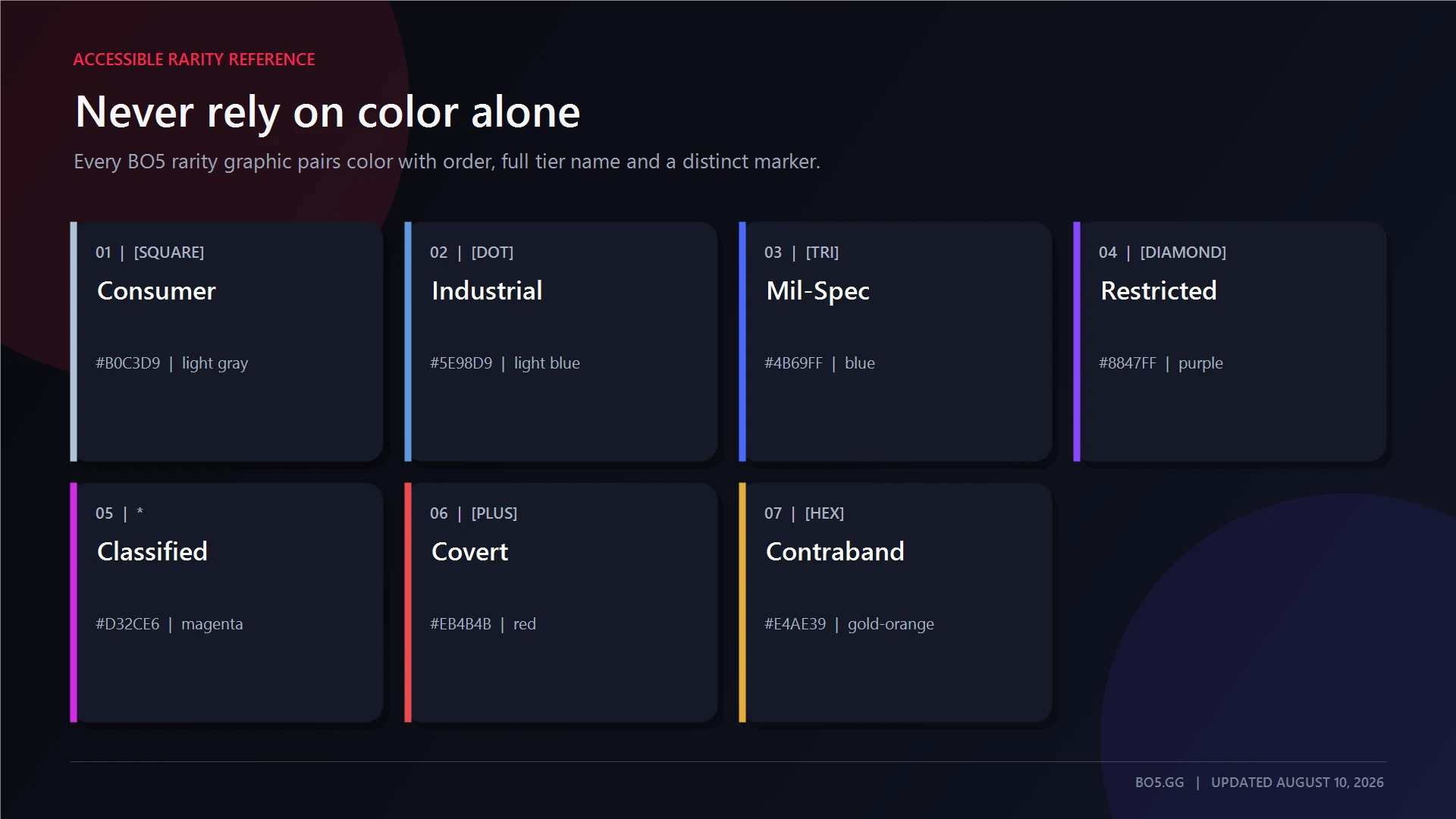
A rarity color identifies an item’s assigned tier. It does not describe the dominant colors in the artwork.
A red Covert skin can have a mostly white, black or blue design. Likewise, a graffiti item called Tiger Orange may still have a Base Grade rarity label.
Every BO5 rarity chart should retain:
- The full tier name
- The numerical order
- A written color description
- A swatch, icon or other non-text cue
Color should never be the only way readers distinguish Industrial Grade from Mil-Spec Grade, or Classified from Covert. This is especially important on mobile layouts and for readers with color-vision differences.
The gold case result also needs its full name. It represents an Exceedingly Rare Special Item outcome and should not be merged with the orange or gold-orange Contraband designation.
Where Knives and Gloves Sit
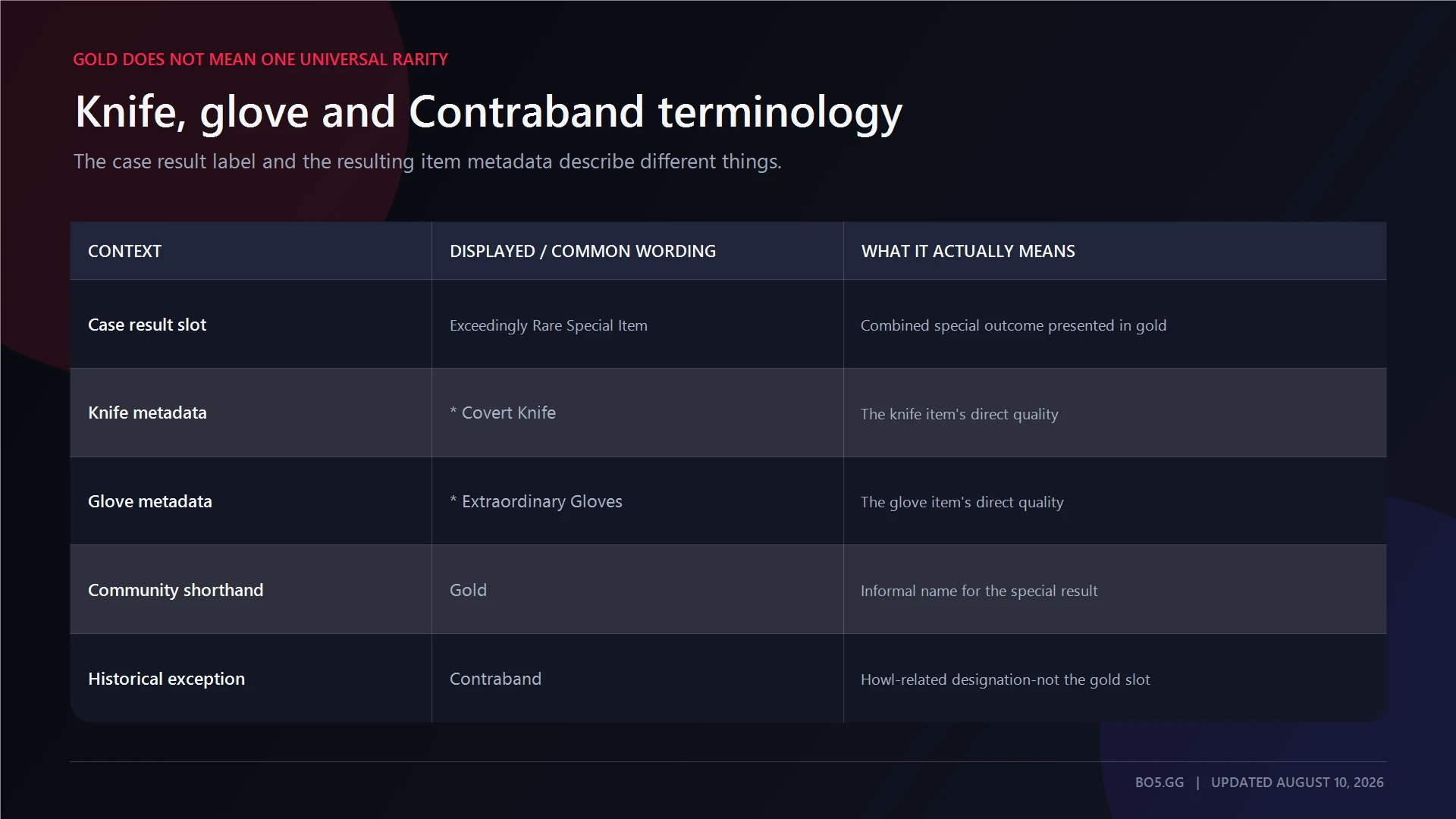
Knives and gloves are presented through a separate special-result slot in containers that include an eligible special-item pool.
For a standard keyed case, the disclosed chance is 0.256%, or approximately one result in 391 openings over a large sample. The precise knife or glove families available depend on the container.
| Display context | Typical wording | What it represents |
|---|---|---|
| Case-opening result slot | Exceedingly Rare Special Item | The gold-presented special outcome |
| Knife item metadata | ★ Covert Knife | The resulting knife’s direct quality |
| Glove item metadata | ★ Extraordinary Gloves | The resulting glove’s direct quality |
| Community shorthand | Gold | An informal description of the case result |
| Historical exception | Contraband | The Howl-related designation, not the normal gold result |
This is why gold should not be treated as a universal eighth weapon rarity.
The case interface describes the roll or outcome slot. The inventory item or marketplace record describes the resulting item’s own type and quality. Those labels are related, but they are not interchangeable.
Container wording also varies. A case may promise an Exceedingly Rare Special Item, an Exceedingly Rare knife family or an Exceedingly Rare gloves result. Use the wording shown by the specific container rather than assuming every gold slot has the same pool.
The word Gold can also describe a sticker effect. A Gold sticker is not automatically Extraordinary, just as a gold-presented knife result is not an item formally labeled Gold.
Rarity Is Not Float, StatTrak, or Souvenir
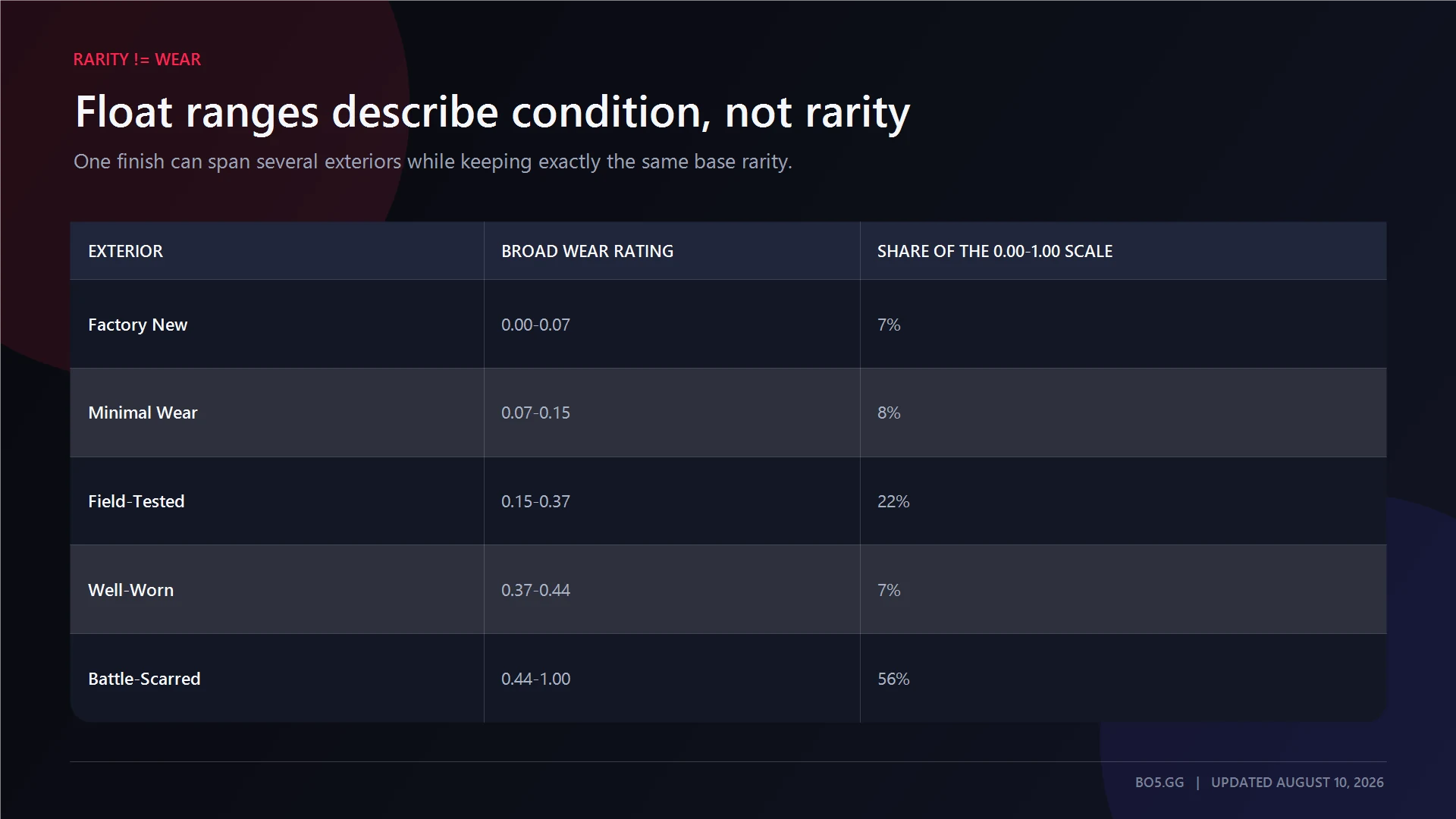
Rarity belongs to the underlying item definition. Most other attributes belong to one individual copy or describe how it entered the economy.
| Attribute | What it describes | Changes base rarity? | Can affect price? |
|---|---|---|---|
| Rarity, grade or quality | The tier assigned to the item definition | — | Yes |
| Float or Wear Rating | The numeric wear value of one copy | No | Often |
| Exterior | Factory New through Battle-Scarred | No | Often |
| Pattern Template | Pattern placement or variation | No | Sometimes dramatically |
| StatTrak | A supported kill-counter variant | No | Often |
| Souvenir | Tournament or current Souvenir-crafting provenance | No | Often |
| Collection | The source and possible trade-up output pool | No | Yes |
| Attached stickers or charms | Accessories applied to one copy | No | Sometimes |
| Market value | What buyers and sellers currently agree on | No | — |
The familiar exterior bands are:
| Exterior | Broad Wear Rating range |
|---|---|
| Factory New | 0.00–0.07 |
| Minimal Wear | 0.07–0.15 |
| Field-Tested | 0.15–0.37 |
| Well-Worn | 0.37–0.44 |
| Battle-Scarred | 0.44–1.00 |
Not every finish supports the full range, so some skins cannot exist in all five exteriors.
Pattern is separate again. Two copies can share the same skin, rarity and exterior while looking different because they have different Pattern Templates or slightly different Wear Ratings.
StatTrak is also a variant rather than a tier. A StatTrak Covert remains Covert, and a normal Covert is not moved down the ladder simply because it lacks a counter.
Souvenir works the same way. It records a particular form of provenance or crafting history without replacing the underlying Consumer Grade, Industrial Grade, Mil-Spec Grade, Restricted, Classified or Covert label.
To compare individual copies, preview the skin’s float and pattern instead of judging the rarity label alone.
How Trade Ups Move Between Rarities
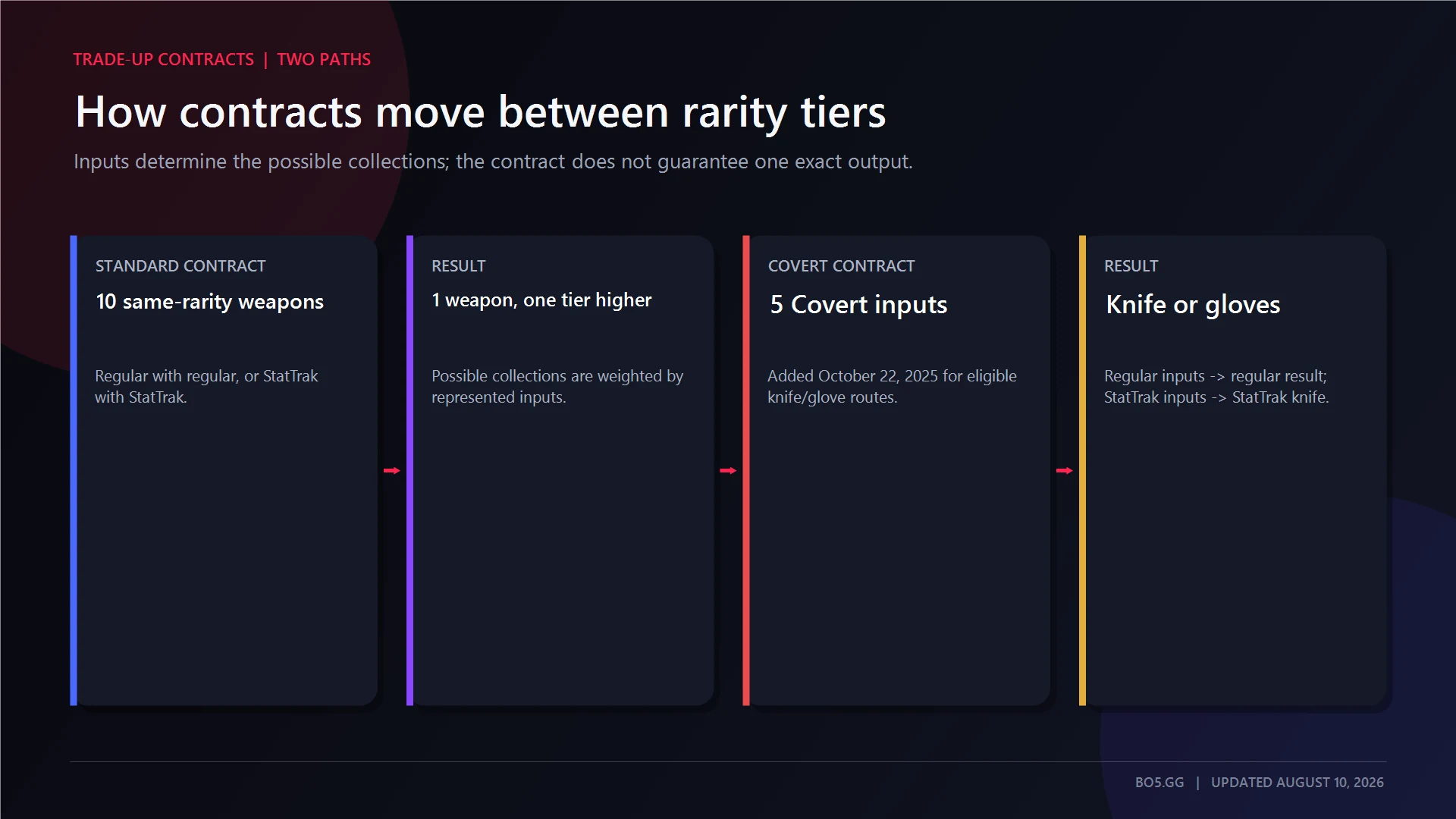
A standard Trade Up Contract uses 10 regular weapons or 10 StatTrak weapons of the same rarity to produce one item one tier higher. The collections represented by the inputs determine the possible output pool.
The normal progression follows the weapon ladder:
- Consumer Grade to Industrial Grade
- Industrial Grade to Mil-Spec Grade
- Mil-Spec Grade to Restricted
- Restricted to Classified
- Classified to Covert
Valve changed the top of that system on October 22, 2025.
Five regular Covert items can now produce one regular knife or gloves item from a collection represented by the inputs. Five StatTrak Covert items can produce one StatTrak knife from a represented collection.
Older guides claiming that Trade Up Contracts always stop at Covert are therefore out of date.
The update did not turn knives into Contraband or make gold a universal item quality. It added a special output route above five Covert inputs while preserving the existing item labels.
Valve has not publicly documented one universal mixed-collection weighting formula or a fixed knife-versus-gloves split. Results should be evaluated using the exact eligible inputs and pools shown by the current contract interface.
A May 22, 2026 update also allowed Souvenir items to be selected in Trade Up Contracts. Their Souvenir attributes are removed, and the result is a normal item from the represented collections. Souvenir remains a provenance category rather than a rarity tier.
The Other Rarity Ladders in CS2
Weapon skins are only one of several naming systems. CS2 reuses some colors across item families while changing the labels.
| Item family | Rarity order, low to high | Important distinction |
|---|---|---|
| Weapon finishes | Consumer Grade → Industrial Grade → Mil-Spec Grade → Restricted → Classified → Covert | Contraband is an exceptional historical designation |
| Stickers | High Grade → Remarkable → Exotic → Extraordinary | Holo, Foil, Glitter, Gold and Lenticular describe effects, not universal rarities |
| Graffiti | Base Grade → High Grade → Remarkable → Exotic | The usable paint color is separate from rarity |
| Charms | High Grade → Remarkable → Exotic → Extraordinary | Template variation is separate from rarity |
| Agents | Distinguished → Exceptional → Superior → Master | Agent labels should not be replaced with weapon-tier names |
| Containers | Commonly Base Grade Container | Supply, contents and market price are separate |
Stickers and Graffiti
Stickers use High Grade, Remarkable, Exotic and Extraordinary.
Paper, Glitter, Holo, Foil, Lenticular and Gold describe a sticker’s visual effect or construction. A Holo sticker is not automatically one fixed rarity, and a Gold sticker is not automatically Extraordinary.
The Howling Dawn sticker is the historical Contraband exception. Current marketplace metadata may instead expose a High Grade quality field, so its historical status and present market label should be stated separately.
Graffiti uses Base Grade, High Grade, Remarkable and Exotic in the current catalog reviewed for this guide. A name such as Tiger Orange identifies the spray color, not the item tier.
Charms
Charms use High Grade, Remarkable, Exotic and Extraordinary.
Valve introduced charms with the 2024 Armory update and expanded the available collections in October 2025. Individual charms can also have a separate template value that changes their appearance without changing their rarity.
Attaching or detaching a charm does not move it to another tier. The charm keeps its own rarity, while the weapon keeps its separate weapon-finish rarity.
Agents and Containers
Agents use their own four-tier ladder:
Distinguished → Exceptional → Superior → Master
The colors broadly parallel blue, purple, pink and red, but the exact agent labels should remain visible. A Master agent is not a Covert agent, even though both use the red color family.
Cases, capsules, terminals and other containers reviewed for this guide are generally described as Base Grade Containers. An expensive discontinued case can still have the same formal container quality as a cheap, widely available one.
Community phrases such as rare case usually refer to supply, availability or drop-pool status rather than the formal quality printed on the container.
Does Rarity Decide Price?
No. Rarity influences how an item enters the economy, but it does not set a guaranteed market price.
Weapon popularity, collection availability, float, pattern, exterior, StatTrak or Souvenir status, applied accessories, liquidity and buyer demand can outweigh the nominal tier.
The following examples are dated snapshots, not tier averages or buying recommendations.
| Rarity | Representative item | Approximate observed price | Snapshot source and date |
|---|---|---|---|
| Consumer Grade | G3SG1 | Red Jasper, Field-Tested | $0.03 | Steam Market, August 10, 2026 |
| Industrial Grade | AK-47 | Olive Polycam, Field-Tested | $0.13 | Steam Market, August 10, 2026 |
| Mil-Spec Grade | AUG | Trigger Discipline, Well-Worn | $0.13 | Steam Market, August 10, 2026 |
| Restricted | AWP | Atheris, Field-Tested | $6.09 | Steam Market, August 10, 2026 |
| Classified | AK-47 | Ice Coaled, Field-Tested | $5.86 | Steam Market, August 10, 2026 |
| Covert | AK-47 | Inheritance, Battle-Scarred | $45.67 | Steam Market, August 10, 2026 |
The Restricted example was slightly more expensive than the Classified example in the same dated snapshot. That is the practical lesson: a higher rarity can limit supply, but it does not guarantee a higher live price.
A Covert skin from a heavily opened case may also cost less than a lower-tier skin from a collection that no longer supplies new copies.
For focused comparisons within one tier, see the cheapest Covert skins in CS2. If you are choosing a container by current availability, standout finishes, or knife and glove families, compare BO5’s best CS2 cases to open.
See Live CS2 Skin and Match Data on BO5.gg
Start with the item’s complete rarity label. Then inspect its float, exterior, Pattern Template and collection before comparing listings.
Use BO5’s CS2 skin inspect server to examine individual copies, and follow live CS2 matches, rankings and schedules across the wider game.
FAQs
What is the rarest skin rarity in CS2?
Contraband is the rarest exceptional weapon-finish designation. Valve assigned it to the M4A4 | Howl in 2014 after replacing its disputed artwork and removing its original creation route.
Contraband is not a standard case result or ordinary trade-up destination. Current marketplace metadata may still display the Howl as Covert, so the historical Contraband designation should be distinguished from the present market quality field.
Is a high float rare?
Float and rarity are separate values.
Rarity is the fixed tier assigned to the finish. Float is the Wear Rating assigned to one individual copy. A very high float can be unusual or desirable for a particular finish, especially when the finish has a restricted wear range, but it does not move the item to a higher rarity.
A 0.99 Consumer Grade skin remains Consumer Grade.
How rare is a red skin in CS2?
A red weapon label means Covert.
In the standard keyed-case structure, Covert weapons have an official probability of 0.639%, or roughly one in 156 openings over a sufficiently large sample. The separate Exceedingly Rare Special Item outcome is lower at 0.256%, or approximately one in 391.
Does rarity make a skin valuable?
Rarity can limit supply, but it does not guarantee value.
A Covert from a heavily opened case may cost less than a Restricted or Classified item from an unavailable collection. Weapon popularity, float sensitivity, pattern demand and current supply can all matter more than the tier when comparing individual skins.
See the cheapest Covert skins in CS2 for examples within one rarity.
Can you trade up to a knife in CS2?
Yes. Since Valve’s October 22, 2025 update, five regular Covert items can produce a regular knife or gloves item from a represented collection.
Five StatTrak Covert items can produce a StatTrak knife. The exact possible outputs depend on the eligible collections represented by the inputs.
Do charms and stickers use the same rarity tiers as weapon skins?
No.
Stickers and charms use High Grade, Remarkable, Exotic and Extraordinary. Weapon finishes use Consumer Grade through Covert, with Contraband as an exceptional historical designation. Agents use Distinguished through Master.
What is the difference between grade and rarity in CS2?
Players often use grade, rarity, tier and quality to discuss the same classification system, but the exact displayed wording varies by item family and interface.
Weapon labels include names such as Consumer Grade and Mil-Spec Grade. Item or marketplace metadata may expose a Quality field. Use the complete displayed label rather than relying only on a color or community nickname.
Why do standard cases not drop Consumer Grade skins?
The regular keyed-case structure starts at Mil-Spec Grade.
Consumer Grade and Industrial Grade weapons appear in collection-based systems, souvenir packages and other pools instead. Some nonstandard containers use different ladders, so this rule should not be applied to every acquisition system in CS2.
Written by

Muhib Nadeem
11 published articles
CS2 writer and BO5 editor covering Counter-Strike guides, rankings, skins, and performance fixes.
Recommended posts
August 9, 2026
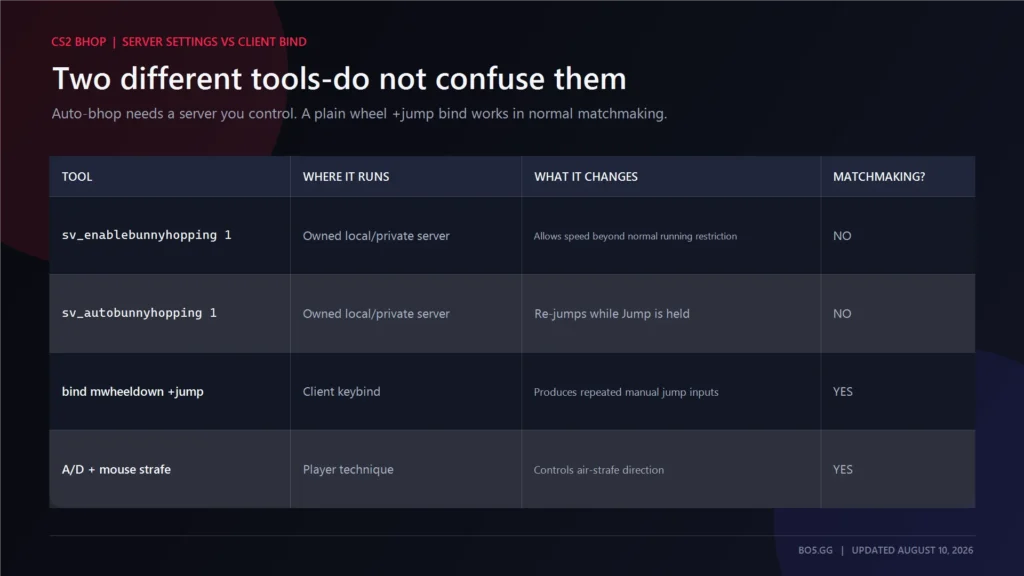
CS2 Bunny Hop Command: How to Enable Bhop
Enable auto-bhop on a CS2 server you control, adjust optional practice settings, use a matchmaking-safe wheel bind, and restore every value correctly.
August 9, 2026
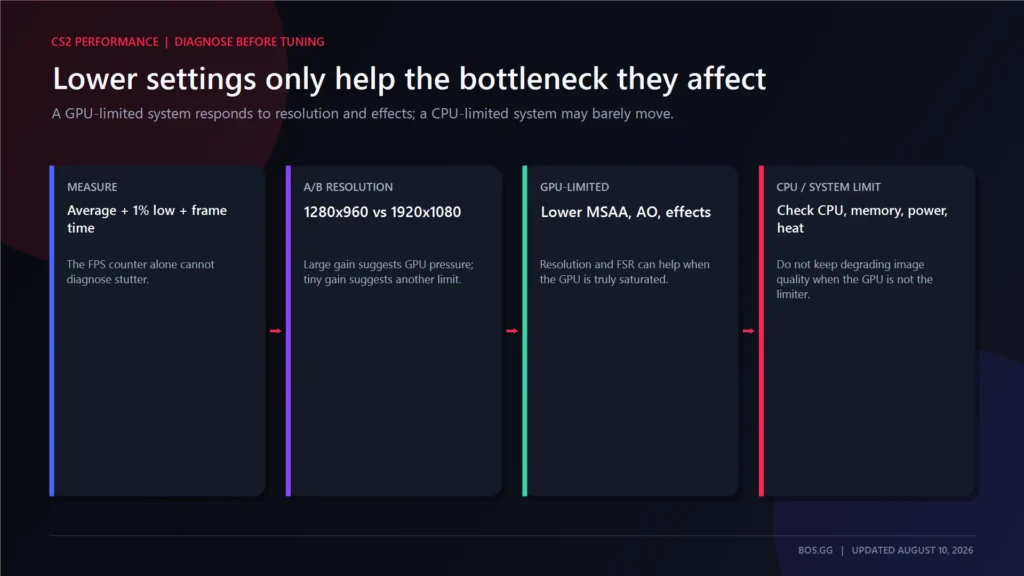
Best CS2 Settings for FPS and Lower Input Lag
Choose CS2 settings for your hardware and display, separate lowest latency from tear-free VRR, preserve competitive visibility, and benchmark every change.
August 9, 2026
CS2 Viewmodel Settings: Every Command, FOV and Pro Config
Configure your CS2 viewmodel with current commands, defaults, practical presets and dated pro snapshots—without confusing weapon FOV with camera FOV or FPS.