
 Counter-Strike 2
 Valorant
 Dota 2
 League of Legends
FACEIT ranks in CS2 are ten skill levels derived from Elo, the numerical rating that changes after matches. “Rank” can also mean a country or regional leaderboard position, so context matters. Challenger is not Level 11: it is the live top 1,000 Level 10 players in a region, with no fixed Elo cutoff.
Verified on 30 August 2026: FACEIT CS2 is in Season 9, which launched on 5 August 2026. FACEIT had not published a precise Season 9 end date in the official pages reviewed.
What Are the FACEIT Ranks in CS2?
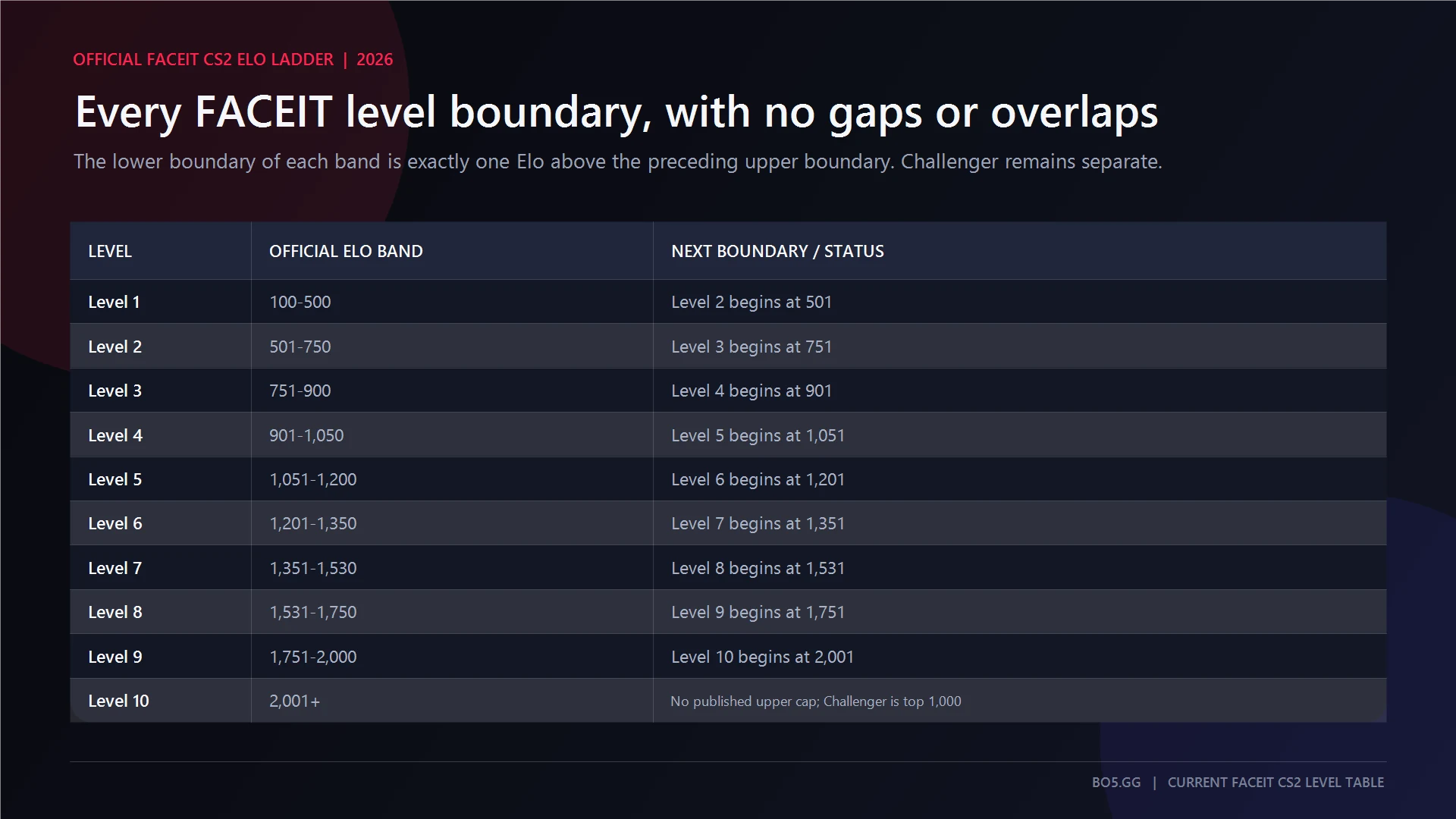
FACEIT officially calls its ranks skill levels. There are ten levels, and your current Elo places you directly into one of them. Players commonly say “FACEIT rank,” but level, Elo, country rank, and regional rank are different things.
| FACEIT level | Official CS2 Elo range | Boundary note |
|---|---|---|
| Level 1 | 100-500 | Level 2 starts at 501 |
| Level 2 | 501-750 | Level 3 starts at 751 |
| Level 3 | 751-900 | Level 4 starts at 901 |
| Level 4 | 901-1,050 | Level 5 starts at 1,051 |
| Level 5 | 1,051-1,200 | Level 6 starts at 1,201 |
| Level 6 | 1,201-1,350 | Level 7 starts at 1,351 |
| Level 7 | 1,351-1,530 | Level 8 starts at 1,531 |
| Level 8 | 1,531-1,750 | Level 9 starts at 1,751 |
| Level 9 | 1,751-2,000 | Level 10 starts at 2,001 |
| Level 10 | 2,001 and above | No published upper cap |
| Challenger | Regional top 1,000 Level 10 players | No fixed Elo threshold |
These are inclusive ranges. A player at 1,750 Elo is still Level 8; reaching 1,751 moves that player to Level 9. Use this CS2-specific table rather than an older generic FACEIT table that shows different brackets for other game contexts.
Level 10 is the highest FACEIT skill level. Challenger is the highest live regional status, but it sits on top of Level 10 rather than forming an eleventh level.
Elo, Level, Rank, and Challenger Explained
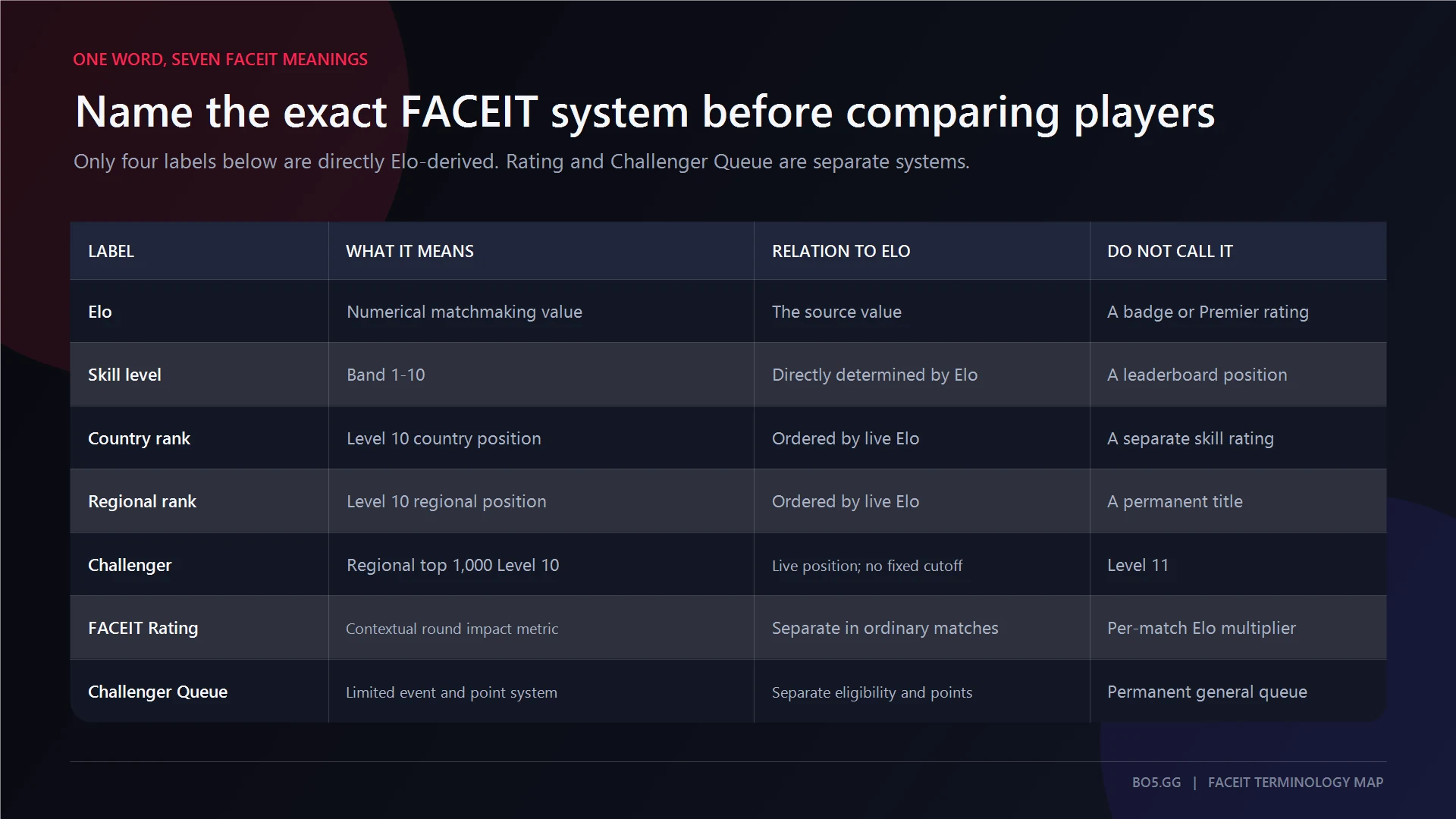
The word “rank” is too broad for precise FACEIT guidance. The safest approach is to name the exact number, band, or leaderboard position being discussed.
| Term | Verified meaning | What it is not |
|---|---|---|
| Elo | Your numerical CS2 matchmaking rating, starting at 100 with no published upper cap | FACEIT Rating or a leaderboard place |
| Skill level | One of ten bands determined directly by Elo | A separate progression score |
| Country rank | A Level 10 player’s Elo position within their home country | The qualification rule for Challenger |
| Regional rank | A live Elo position on the selected regional leaderboard | A permanent seasonal finish |
| Challenger | Live status for a regional top-1,000 Level 10 player | Level 11 or a fixed Elo number |
| FACEIT Rating | A contextual performance measure based on round impact | A second Elo ladder |
| Permanent Challenger badge | A season-end award governed by that season’s eligibility and snapshot rules | Automatic proof that a player was always Challenger |
FACEIT Rating uses the Round Swing model to assess how actions changed a team’s chance of winning a round. Damage, utility, trades, objectives, economy, equipment, and match context can all matter. FACEIT has used values around 0.7, 1.1, and 1.4 as performance examples, not as rank thresholds.
Rating was introduced as separate from ordinary Elo and matchmaking. In Season 9, however, recent FACEIT Rating became one input to the seasonal soft reset. That does not make Rating a direct per-match Elo multiplier.
How Do You Check Your FACEIT Rank?
On FACEIT, open the profile and read the account widget: Levels 1–9 show progress within the current band, while Level 10 adds country and regional positions. To inspect another profile, BO5’s FACEIT Finder retrieves its current level and Elo while this guide explains what the result means. Search with the player’s nickname, FACEIT ID, SteamID64, or Steam profile URL, then use the level table above to interpret the returned number.
How Does FACEIT Elo Change After a Match?
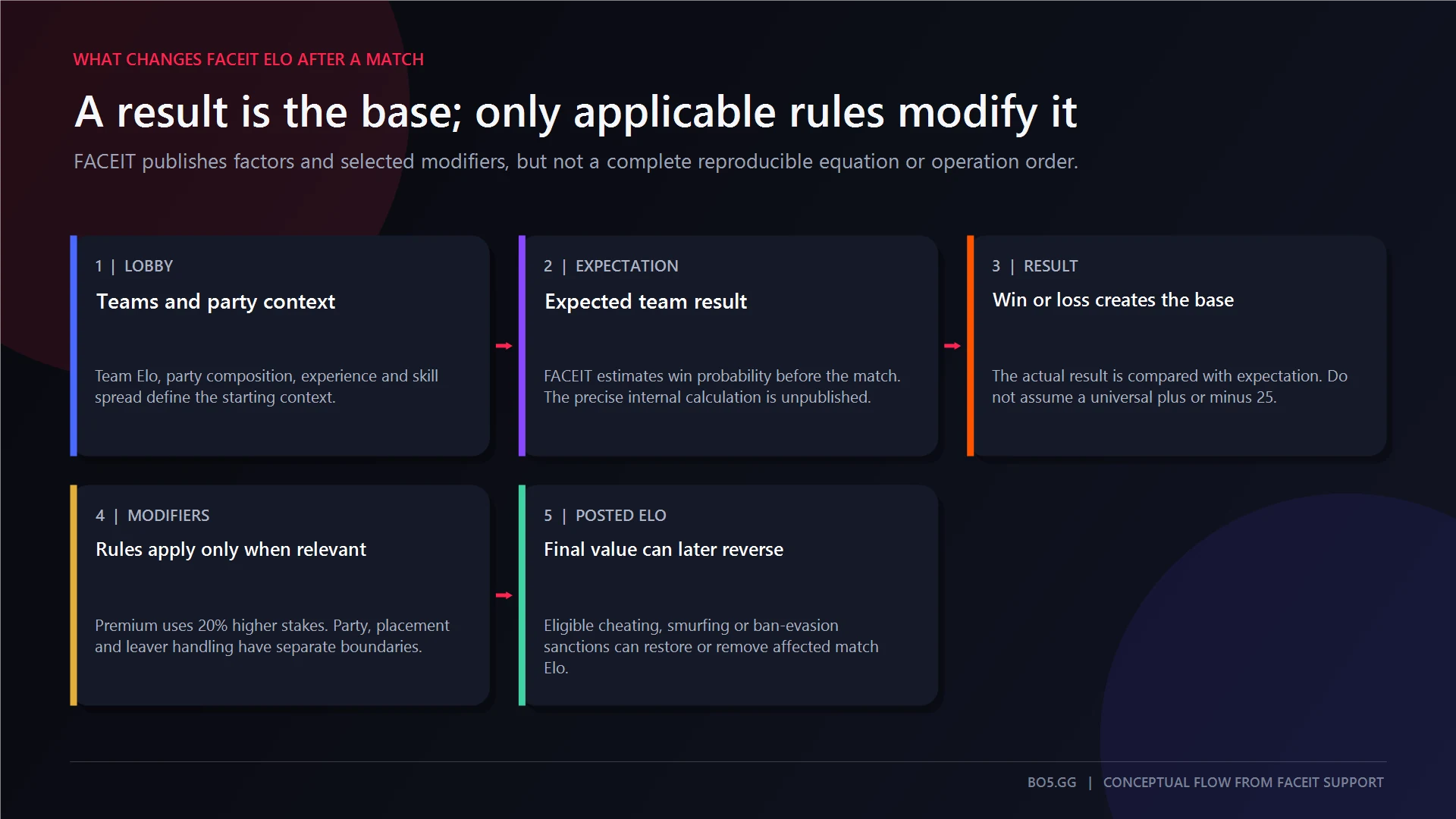
FACEIT does not award a universal amount such as plus or minus 25 Elo. The calculation is dynamic, and the complete formula, coefficients, caps, rounding, and mathematical order are private.
The publishable model is:
- FACEIT evaluates the teams when the lobby launches.
- It estimates each team’s chance of winning.
- The win or loss creates the main Elo result.
- Applicable queue, party, placement, performance, and leaver rules can modify it.
- A later qualifying cheating, smurfing, or ban-evasion sanction can reverse eligible match Elo.
The balance calculation can consider team skill, party composition, matches played, and the skill spread inside each team. A favorite should normally gain less for the expected win and risk more in an upset, while an underdog can gain more for winning. FACEIT does not expose enough detail to reproduce the number from visible averages alone.
Does Individual Performance Affect Elo?
For Levels 1-9, a notably impactful performance can make a small contextual difference. It is not a fixed kill, K/D, damage, or scoreboard bonus, and most matches receive little or no extra variation. Level 10 is excluded from this individual-performance layer.
This means both common extremes are wrong. K/D does not directly determine Elo, but individual impact is not always irrelevant below Level 10. Winning, losing, and the expected team result remain the main drivers.
Premium, Standard, Super, and Party Disparity
| Match type | Current party guidance | Elo effect |
|---|---|---|
| Standard | No additional Standard party-size or party-Elo restriction is stated | Normal dynamic calculation |
| Premium | Party of one or two; normally no more than 400 Elo apart | 20% more Elo gained or lost than the applicable result |
| Super | Party of one to three; normally no more than 400 Elo apart | Normal dynamic calculation unless another rule applies |
Premium is not automatically plus or minus 30. For a worked arithmetic example, if the otherwise applicable result were 20 Elo, Premium’s 20% increase would make it 24 before any private rounding. The 20-Elo base is only an illustration, not a prediction.
FACEIT can apply internal weighting when party members have a large skill gap. The exact disparity penalty is not public. Current Match Types guidance says Level 1 and Level 10 players can sometimes see spreads above 400 because of matchmaking constraints. Parties containing a player above 2,800 Elo can face separate matchmaking and Elo adjustments, but FACEIT does not publish the penalty curve.
Premium selection is currently documented for eligible players in Europe and North America. Super selection is documented for subscribers across regions, while eligible free players can still be placed into a Super Match.
How Do Season 9 Placements, Resets, and Inactivity Work?
Season 9 began on 5 August 2026 with a lighter all-account soft reset. Active and inactive accounts were reset at the same time, and each player received ten placement matches before FACEIT finalized the new starting Elo.
FACEIT says the Season 9 calculation considers:
- Ending Elo before the reset.
- Activity and recent win rate.
- FACEIT Rating and performance context across the latest 50 matches.
- Whether the player recorded at least 20 wins in Season 8.
- The ten Season 9 placement results.
Placement matches carry more weight than ordinary games, but FACEIT has not published the multiplier. Players above 2,500 Elo were generally expected to start lower, with the strongest compression applied to the highest-Elo Level 10 accounts. Active players below Level 10 could finish placements above their previous Elo after strong results.
Season 9 also differs from Season 8 in how the interface is described. Season 8 explicitly hid Elo until all ten placements were complete. Season 9 says the final starting Elo is established after ten matches and shows whether each result helped or hurt it. Repeating Season 8’s blanket “Elo is hidden” rule for Season 9 would be inaccurate.
Does FACEIT Elo Reset or Decay?
A stale competitor claim says FACEIT Elo “never resets or decays.” That wording is incorrect.
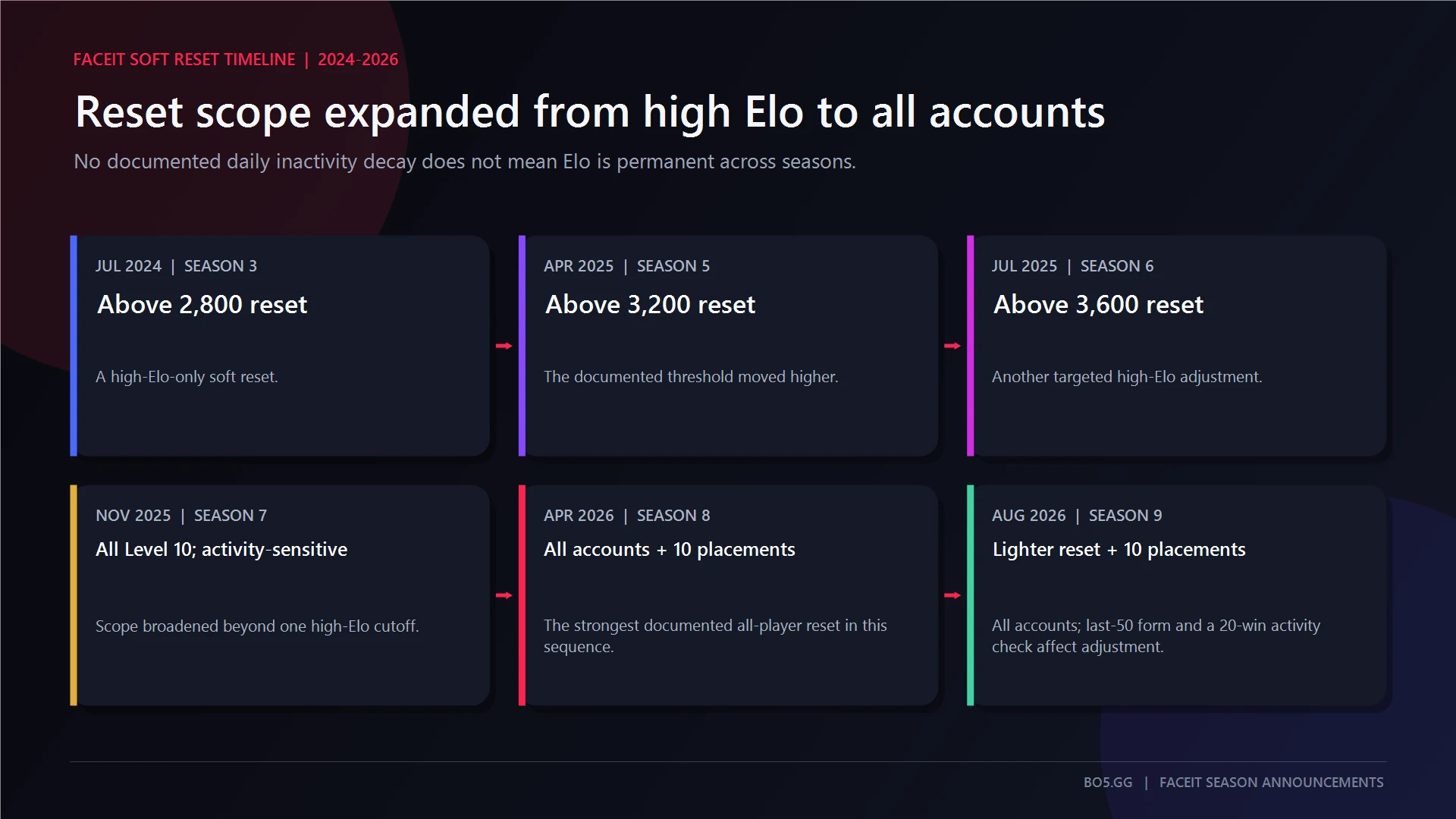
FACEIT does not currently document passive day-by-day or week-by-week inactivity decay. It does document seasonal soft resets, and recent reset formulas can move inactive accounts further downward. In Season 9, players with fewer than 20 Season 8 wins could receive an additional inactivity adjustment.
| Season | Effective date | Documented reset scope |
|---|---|---|
| Season 3 | 4 July 2024 | Level 10 players above 2,800 Elo |
| Season 5 | 8 April 2025 | Players above 3,200 Elo |
| Season 6 | 21 July 2025 | Players above 3,600 Elo |
| Season 7 | 19 November 2025 | All Level 10 accounts, with activity sensitivity |
| Season 8 | 22 April 2026 | Every account, plus ten placements |
| Season 9 | 5 August 2026 | Every account, lighter reset, ten placements and recent-form inputs |
Starting Elo for a New FACEIT Player
Newcomer seeding is separate from seasonal placements. An eligible first-time CS2 player can have recent Premier history translated into initial FACEIT Elo through an unpublished formula. FACEIT does not publish a universal conversion or the full eligibility formula. Players who do not qualify use the documented 1,000-Elo fallback.
What Happens With Leavers, Cooldowns, and Missing Elo?
FACEIT applies specific Elo rules once cumulative disconnection time exceeds five minutes. Reconnecting later does not remove the leaver tag from that match.
| Situation | Verified result |
|---|---|
| Tagged leaver’s team loses | The leaver loses twice the normally calculated Elo |
| Tagged leaver’s team wins | The leaver receives half the normal gain |
| Non-premade teammate loses with a leaver | Half of the expected loss |
| Premade teammate loses with their leaver | Full normal loss |
| Match is hidden from public history | Elo can still change; missions or seasonal ladder progress may not count |
| First AFK, leaver, or noShow penalty | Cooldown starts at 30 minutes |
| Repeated incidents | Cooldowns escalate dynamically across a rolling 30-day history |
A hidden leaver match can make a third-party tracker appear to show an Elo loss after a later win because the tracker combines the unseen loss with the next visible result.
FACEIT Support generally does not remove penalties caused by local internet failures, hardware crashes, or ordinary Steam and client problems. It may act when platform-side or server-side faults are verified in its logs. For prevention, you can diagnose CS2 net jitter or stabilize FPS and frame time, but client changes cannot erase an Elo result or cooldown already applied.
Ban-related Elo reversions are also limited. They cover qualifying permanent cheating, smurfing, or ban-evasion sanctions within the documented last-100-match and three-month windows. A conduct penalty or unrelated ban does not automatically return Elo.
How Do Challenger and FACEIT Leaderboards Work?
Challenger requires two things: Level 10 and a live place inside the top 1,000 of the relevant regional leaderboard. Because it is positional, the required Elo rises or falls with the region’s active ladder. A player can lose Challenger and later regain it.
Country rank and regional rank are not interchangeable. Country rank compares Level 10 players associated with one home country. Regional rank is the broader position used for Challenger qualification. FACEIT’s live regional surfaces display rank, player, country, level, and Elo, with special presentation for the top three.
Live Challenger status is also separate from a permanent seasonal badge. The latest explicit standard badge rules found were for Season 7, including regional activity and win requirements. Those rules should not be presented as confirmed Season 9 policy. No current official tie-breaking rule for the ordinary CS2 Elo leaderboard was located.
Season 9’s Challenger Queue was another separate product: a limited European event held from 5 to 9 August 2026 with its own points and eligibility rules. It was not the normal Challenger ladder.
For professional-team standings rather than FACEIT player positions, use BO5’s CS2 world rankings.
How Do FACEIT Levels Compare With CS2 Premier?
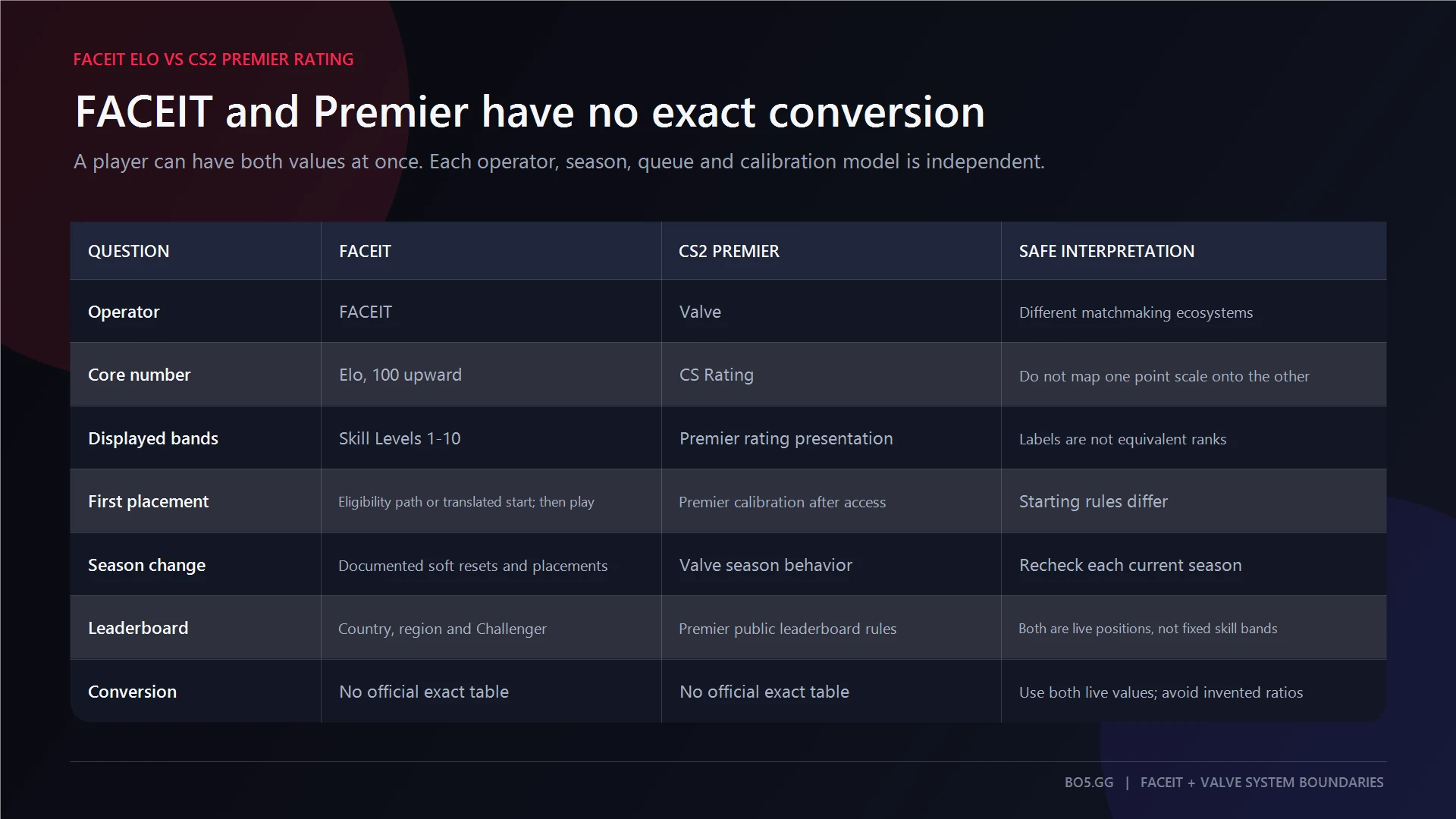
There is no official or defensible numerical conversion between FACEIT Elo and CS2 Premier CS Rating. The systems use different player populations, matchmaking conditions, seasonal structures, and private formulas.
| Dimension | FACEIT | CS2 Premier |
|---|---|---|
| Core number | Elo | CS Rating |
| Visible bands | Ten fixed skill levels; Level 10 is open-ended | Valve’s rating presentation and leaderboard structure |
| Top status | Regional top-1,000 Challenger position | Premier leaderboard position under Valve’s rules |
| Matchmaking population | FACEIT players and eligible competitions | Valve Premier participants |
| Official conversion | None published | None published |
The one documented bridge is onboarding. FACEIT can use an eligible new player’s recent Premier history as a signal for initial Elo, but the translation formula is private. That does not prove that a particular Premier rating always equals a particular FACEIT level.
Higher skill in one system will often correlate with higher skill in the other, but any exact conversion table creates false precision. For Valve-side terminology, see BO5’s guide to CS2 Premier and Competitive ranks.
Why Boosted FACEIT Accounts Are Not Worth It
Boosting and account buying do not create durable skill. They can breach FACEIT’s rules, expose the account to restrictions or recovery by its original owner, and place the buyer into matches above their real level. BO5 does not name or link boosting services. Improving on your own account is the only route that preserves ownership, an honest match history, and a level you can actually sustain.
FACEIT Rank Questions
Is 3000 Elo Good on FACEIT?
Yes. 3,000 Elo is Level 10, well above the 2,001 entry boundary. It still does not guarantee Challenger, because Challenger requires a live top-1,000 position on the relevant regional leaderboard. The cutoff moves with that region’s active players.
Is 1200 Elo Good on FACEIT?
1,200 Elo is Level 5, at the top of its official band; Level 6 begins at 1,201. It sits around the middle of the ten-level ladder, but FACEIT does not publish a current population distribution that would justify calling it an exact percentile.
What Is the Average FACEIT Level?
FACEIT does not publish a current, complete CS2 level-distribution dataset, so there is no defensible official average to quote. The fallback starting Elo is 1,000, which lies in Level 4, but a starting point is not the same thing as the player-base average.
Do FACEIT Levels Carry Over to CS2 Premier?
No. FACEIT Elo and CS2 Premier CS Rating are separate systems with no official conversion. A player can hold both values at once, but neither transfers into the other. BO5’s guide to CS2 Premier and Competitive ranks explains Valve’s side.
How Many Matches Does It Take to Rank Up on FACEIT?
There is no fixed match count. Subtract your current Elo from the next level boundary, then compare that gap with your own recent gains and losses. Expected result, lobby balance, party rules, placements, leaver status, and other modifiers can change each result, so a wins-only promise would be misleading.
Who Is Number One on FACEIT?
FACEIT leaderboards are regional and change as matches finish, so one undated global name would become stale quickly. Check the live regional leaderboard for the current top position. For a specific player, use the FACEIT Finder and read their current Elo and regional place directly.
FACEIT Rank Sources and Verification, 30 August 2026
FACEIT Support and current FACEIT product surfaces were treated as the source of truth. Older generic pages and secondary guides were used only to identify conflicts, not to override current CS2-specific guidance.
Primary verification pages:
- FACEIT CS2 Elo and skill levels for the current threshold table, starting Elo, visibility, and Challenger basics.
- Season 9: A Lighter Soft Elo Reset for placements, reset inputs, recent form, and inactivity treatment.
- CS2 Match Types FAQ for Standard, Premium, Super, and party restrictions.
- Elo Calculation Issues and the AFK, Leaver, noShow, Bans and Elo FAQ for match changes, hidden results, cooldowns, and reversions.
- FACEIT Rating FAQ, Understanding Round Swing, and What Is Challenger? for performance and leaderboard terminology.
Dynamic details such as the active season, match-type eligibility, regional selectors, permanent Challenger badge rules, and live leaderboard cutoff should be rechecked whenever this article is updated.
Read Your FACEIT Rank Without Guesswork
Use Elo for numerical movement, skill level for the current band, and regional position for Challenger. Check a live profile with the FACEIT Finder instead of guessing from Premier, then use today's CS2 matches for the live competitive schedule. Treat every seasonal rule or leaderboard cutoff as dated rather than permanent.
Written by

Muhib Nadeem
21 published articles
CS2 writer and BO5 editor covering Counter-Strike guides, rankings, skins, and performance fixes.
Recommended posts
August 30, 2026
How to Start Private Matchmaking in CS2
Choose the correct CS2 private-play route, start a ten-human Private Matchmaking pool, preserve teams, and diagnose lobby or server failures safely.

August 30, 2026
How to Unlock Premier in CS2
CS2 Premier requires Prime Status and Profile Level 10 on the same account. This guide separates access, rating calibration, XP planning, and safe lock troubleshooting.
August 30, 2026
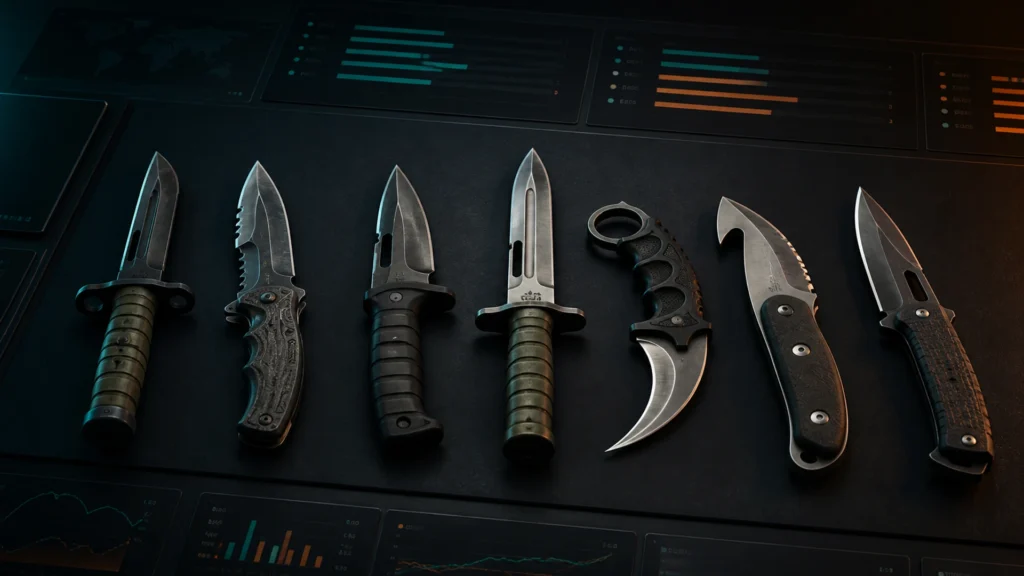
The Cheapest CS2 Knives
A dated comparison of the cheapest normal and StatTrak CS2 knives, including usable cost, wear exceptions, marketplace constraints, and randomized acquisition routes.